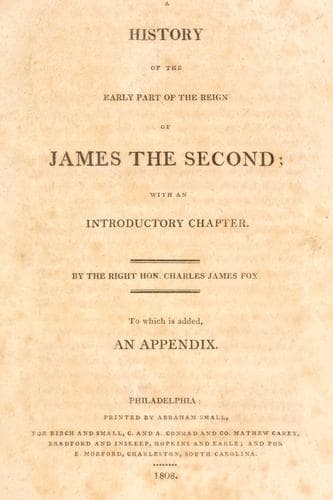
A History of the Early Part of the Reign of James the SecondFox, Charles James
History
A History of the Early Part of the Reign of James the Second
Fox, Charles James
Great Britain -- History -- James II, 1685-1688
These last proceedings had taken place while James himself had the
government in his hands, and under his immediate directions. Not long
after, and when the exclusionists in England were supposed to be entirely
defeated, was passed (James being the king's commissioner), the famous
bill of succession, declaring that no difference of religion, nor any
statute or law grounded upon such, or any other pretence, could defeat
the hereditary right of the heir to the crown, and that to propose any
limitation upon the future administration of such heir was high treason.
But the Protestant religion was to be secured; for those who were most
obsequious to the court, and the most willing and forward instruments of
its tyranny, were, nevertheless, zealous Protestants. A test was
therefore framed for this purpose, which was imposed upon all persons
exercising any civil or military functions whatever, the royal family
alone excepted; but to the declaration of adherence to the Protestant
religion was added a recognition of the king's supremacy in
ecclesiastical matters, and a complete renunciation in civil concerns of
every right belonging to a free subject. An adherence to the Protestant
religion, according to the confession of it referred to in the test,
seemed to some inconsistent with the acknowledgment of the king's
supremacy and that clause of the oath which related to civil matters,
inasmuch as it declared against endeavouring at any alteration in the
Church or State, seemed incompatible with the duties of a counsellor or a
member of parliament. Upon these grounds the Earl of Argyle, in taking
the oath, thought fit to declare as follows:--
"I have considered the test, and I am very desirous to give obedience as
far as I can. I am confident the parliament never intended to impose
contradictory oaths; therefore I think no man can explain it but for
himself. Accordingly I take it, as far as it is consistent with itself
and the Protestant religion. And I do declare that I mean not to bind up
myself in my station, and in a lawful way, to wish and endeavour any
alteration I think to the advantage of the Church or State, not repugnant
to the Protestant religion and my loyalty. And this I understand as a
part of the oath." And for this declaration, though unnoticed at the
time, he was in a few days afterwards committed, and shortly after
sentenced to die. Nor was the test applied only to those for whom it had
been originally instituted, but by being offered to those numerous
classes of people who were within the reach of the late severe criminal
laws, as an alternative for death or confiscation, it might fairly be
said to be imposed upon the greater part of the country.
Public-domain text, read in full here on John Shaqi.
Reviews
Reviews
No reviews yet
Be the first to share your thoughts on this work.
Elsewhere in the archive
Join the Discussion
Join the discussion
Sign in to leave a comment or review.
Sign InorCreate an account