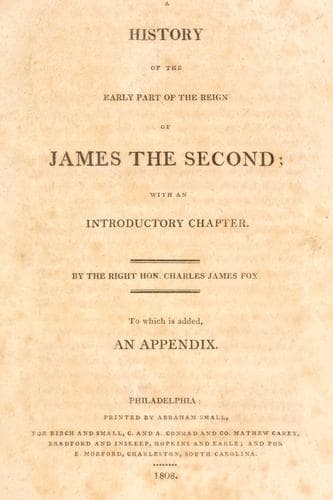
A History of the Early Part of the Reign of James the SecondFox, Charles James
History
A History of the Early Part of the Reign of James the Second
Fox, Charles James
Great Britain -- History -- James II, 1685-1688
not reproved or punished, but deemed a meritorious service by their
superiors. The demise of King Charles, which happened about this time,
caused no suspension or relaxation in these proceedings, which seemed to
have been the crowning measure, as it were, or finishing stroke of that
system, for the steady perseverance in which James so much admired the
resolution of his brother.
It has been judged necessary to detail these transactions in a manner
which may, to some readers, appear an impertinent digression from the
narrative in which this history is at present engaged, in order to set in
a clearer light some points of the greatest importance. In the first
place, from the summary review of the affairs of Scotland, and from the
complacency with which James looks back to his own share of them, joined
to the general approbation he expressed of the conduct of government in
that kingdom, we may form a pretty just notion, as well of his maxims of
policy, as of his temper and disposition in matters where his bigotry to
the Roman Catholic religion had no share. For it is to be observed and
carefully kept in mind, that the Church, of which he not only recommends
the support, but which be showed himself ready to maintain by the most
violent means, is the Episcopalian Church of the Protestants; that the
test which he enforced at the point of the bayonet was a Protestant test,
so much so indeed, that he himself could not take it; and that the more
marked character of the conventicles, the objects of his persecution, was
not so much that of heretics excommunicated by the Pope, as of dissenters
from the Church of England, and irreconcilable enemies to the Protestant
liturgy and the Protestant episcopacy. But he judged the Church of
England to be a most fit instrument for rendering the monarchy absolute.
On the other hand, the Presbyterians were thought naturally hostile to
the principles of passive obedience, and to one or other, or with more
probability to both of these considerations, joined to the natural
violence of his temper, is to be referred the whole of his conduct in
this part of his life, which in this view is rational enough; but on the
supposition of his having conceived thus early the intention of
introducing popery upon the ruins of the Church of England, is wholly
unaccountable, and no less absurd, than if a general were to put himself
to great cost and pains to furnish with ammunition and to strengthen with
fortifications a place of which he was actually meditating the attack.
Public-domain text, read in full here on John Shaqi.
Reviews
Reviews
No reviews yet
Be the first to share your thoughts on this work.
Elsewhere in the archive
Join the Discussion
Join the discussion
Sign in to leave a comment or review.
Sign InorCreate an account