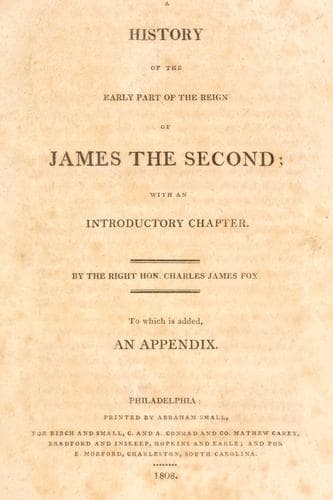
A History of the Early Part of the Reign of James the SecondFox, Charles James
History
A History of the Early Part of the Reign of James the Second
Fox, Charles James
Great Britain -- History -- James II, 1685-1688
The unanimous vote for trusting the safety of religion to the king's
declaration passed not without observation, the rights of the Church of
England being the only point upon which, at this time, the parliament
were in any degree jealous of the royal power. The committee of religion
had voted unanimously, "That it is the opinion of the committee, that
this House will stand by his majesty with their lives and fortunes,
according to their bounden duty and allegiance, in defence of the
reformed Church of England, as it is now by law established; and that an
humble address be presented to his majesty, to desire him to issue forth
his royal proclamation, to cause the penal laws to be put in execution
against all dissenters from the Church of England whatsoever." But upon
the report of the House, the question of agreeing with the committee was
evaded by a previous question, and the House, with equal unanimity,
resolved: "That this House doth acquiesce, and entirely rely, and rest
wholly satisfied, on his majesty's gracious word, and repeated
declaration to support and defend the religion of the Church of England,
as it is now by law established, which is dearer to us than our lives."
Mr. Echard, and Bishop Kennet, two writers of different principles, but
both churchmen, assign, as the motive of this vote, the unwillingness of
the party then prevalent in parliament to adopt severe measures against
the Protestant dissenters; but in this notion they are by no means
supported by the account, imperfect as it is, which Sir John Reresby
gives of the debate, for he makes no mention of tenderness towards
dissenters, but states as the chief argument against agreeing with the
committee, that it might excite a jealousy of the king; and Barillon
expressly says, that the first vote gave great offence to the king, still
more to the queen, and that orders were, in consequence, issued to the
court members of the House of Commons to devise some means to get rid of
it. Indeed, the general circumstances of the times are decisive against
the hypothesis of the two reverend historians; nor is it, as far as I
know, adopted by any other historians. The probability seems to be, that
the motion in the committee had been originally suggested by some Whig
member, who could not, with prudence, speak his real sentiments openly,
and who thought to embarrass the government, by touching upon a matter
where the union between the church party and the king would be put to the
severest test. The zeal of the Tories for persecution made them at first
give into the snare; but when, upon reflection, it occurred that the
involving of the Catholics in one common danger with the Protestant
dissenters must be displeasing to the king, they drew back without delay,
and passed the most comprehensive vote of confidence which James could
desire.
Public-domain text, read in full here on John Shaqi.
Reviews
Reviews
No reviews yet
Be the first to share your thoughts on this work.
Elsewhere in the archive
Join the Discussion
Join the discussion
Sign in to leave a comment or review.
Sign InorCreate an account