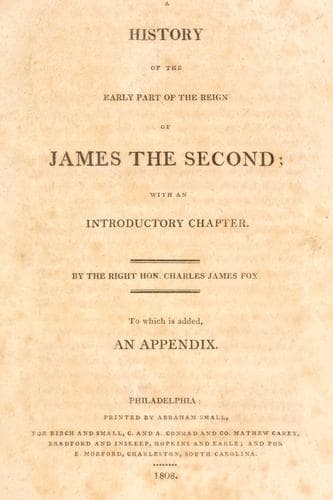
A History of the Early Part of the Reign of James the SecondFox, Charles James
History
A History of the Early Part of the Reign of James the Second
Fox, Charles James
Great Britain -- History -- James II, 1685-1688
Rapin, Hume, and Ralph observe upon this speech, that neither the
generosity of the Commons' grant, nor the confidence they expressed upon
religious matters, could extort a kind word in favour of their religion.
But this observation, whether meant as a reproach to him for his want of
gracious feeling to a generous parliament, or as an oblique compliment to
his sincerity, has no force in it. His majesty's speech was spoken
immediately upon, passing the bills which the Speaker presented, and he
could not therefore take notice of the Speaker's words unless he had
spoken extempore; for the custom is not, nor I believe ever was, for the
Speaker to give beforehand copies of addresses of this nature. James
would not certainly have scrupled to repeat the assurances which he had
so lately made in favour of the Protestant religion, as he did not
scruple to talk of his true English heart, honour of the nation, &c., at
a time when he was engaged with France; but the speech was prepared for
an answer to a money bill, not for a question of the Protestant religion
and church, and the false professions in it are adapted to what was
supposed to be the only subject of it.
The only matter in which the king's views were in any degree thwarted was
the reversal of Lord Stafford's attainder, which, having passed the House
of Lords, not without opposition, was lost in the House of Commons; a
strong proof that the popish plot was still the subject upon which the
opposers of the court had most credit with the public. Mr. Hume,
notwithstanding his just indignation at the condemnation of Stafford, and
his general inclination to approve of royal politics, most unaccountably
justifies the Commons in their rejection of this bill, upon the principle
of its being impolitic at that time to grant so full a justification of
the Catholics, and to throw so foul an imputation upon the Protestants.
Surely if there be one moral duty that is binding upon men in all times,
places, and circumstances, and from which no supposed views of policy can
excuse them, it is that of granting a full justification to the innocent;
and such Mr. Hume considers the Catholics, and especially Lord Stafford,
to have been. The only rational way of accounting for this solitary
instance of non-compliance on the part of the Commons is either to
suppose that they still believed in the reality of the popish plot, and
Stafford's guilt, or that the Church party, which was uppermost, had such
an antipathy to popery, as indeed to every sect whose tenets differed
from theirs, that they deemed everything lawful against its professors.
Public-domain text, read in full here on John Shaqi.
Reviews
Reviews
No reviews yet
Be the first to share your thoughts on this work.
Elsewhere in the archive
Join the Discussion
Join the discussion
Sign in to leave a comment or review.
Sign InorCreate an account