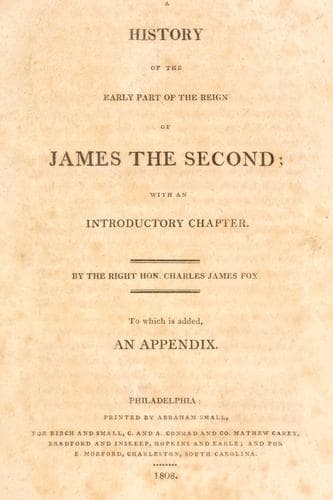
A History of the Early Part of the Reign of James the SecondFox, Charles James
History
A History of the Early Part of the Reign of James the Second
Fox, Charles James
Great Britain -- History -- James II, 1685-1688
It is now necessary to give some account of those attempts in Scotland by
the Earl of Argyle, and in England by the Duke of Monmouth, of which the
king had informed his parliament in the manner recited in the preceding
chapter. The Earl of Argyle was son to the Marquis of Argyle, of whose
unjust execution, and the treacherous circumstances accompanying it,
notice has already been taken. He had in his youth been strongly
attached to the royal cause, and had refused to lay down his arms till he
had the exiled king's positive orders for that purpose. But the merit of
his early services could neither save the life of his father, nor even
procure for himself a complete restitution of his family honours and
estates; and not long after the restoration, upon an accusation of
leasing-making, an accusation founded, in this instance, upon a private
letter to a fellow-subject, in which he spoke with some freedom of his
majesty's Scottish ministry, he was condemned to death. The sentence was
suspended and finally remitted, but not till after an imprisonment of
twelve months and upwards. In this affair he was much assisted by the
friendship of the Duke of Lauderdale, with whom he ever afterwards lived
upon terms of friendship, though his principles would not permit him to
give active assistance to that nobleman in his government of Scotland.
Accordingly, we do not, during that period, find Argyle's name among
those who held any of those great employments of State to which, by his
rank and consequence, he was naturally entitled. When James, then Duke
of York, was appointed to the Scottish government, it seems to have been
the earl's intention to cultivate his royal highness's favour, and he was
a strenuous supporter of the bill which condemned all attempts at
exclusions or other alterations in the succession of the crown. But
having highly offended that prince by insisting, on the occasion of the
test, that the royal family, when in office, should not be exempted from
taking that oath which they imposed upon subjects in like situations, his
royal highness ordered a prosecution against him, for the explanation
with which he had taken the test oath at the council-board, and the earl
was, as we have seen, again condemned to death. From the time of his
escape from prison he resided wholly in foreign countries, and was looked
to as a principal ally by such of the English patriots as had at any time
entertained thoughts, whether more or less ripened, of delivering their
country.
Public-domain text, read in full here on John Shaqi.
Reviews
Reviews
No reviews yet
Be the first to share your thoughts on this work.
Elsewhere in the archive
Join the Discussion
Join the discussion
Sign in to leave a comment or review.
Sign InorCreate an account