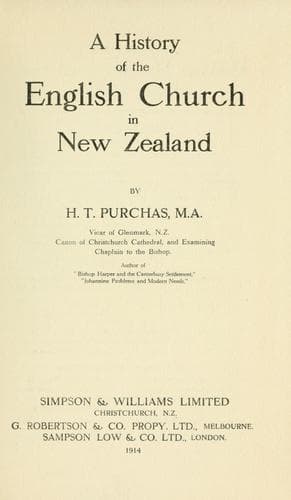
A History of the English Church in New ZealandPurchas, Henry Thomas
History
A History of the English Church in New Zealand
Purchas, Henry Thomas
Church of the Province of New Zealand -- History; New Zealand -- Church history
But what of the other prisoner? He was now strictly guarded, and could
learn nothing about his friend, except what he gathered from a whisper
which he overheard among the sentries: "Hung on the willow tree."
Together with the sailors and other Europeans, he was now marched to the
spot to which Volkner had first been led. But there was no repetition of
the tragedy. There was robbing of pockets, binding of hands, and an
exhibition of bullying tyranny; but the lust for blood had abated. With
the cryptic utterance, "A time to bind, and a time to loose; a time to
kill, and a time to make alive," the bonds were loosed from all the
party, and they were bidden to stay for the night in the house of a sick
settler named Hooper.
It was a night of horror. In the one small room--18ft. by 12ft.--there
were crowded the sick man, four sailors, the missionary, and "six or
eight natives--men, women, and children. The suffocation from so many
people and from the fumes of tobacco was almost overpowering." Grace had
just heard certain news of his friend's fate, and had "every reason to
believe that it would be his own last night on earth." Again as he lay
awake he could hear "the dancing and shouting going on in the Romish
chapel, and also in the church." Again the sailors showed their humanity
by sharing their coats and blankets. But there were no evening prayers
now, for there was too much moving about. Even his Prayer Book had been
carried off: "I could only in private commend myself and my companions
to the watchful care of our Heavenly Father. Thus ended this terrible
day, upon which the first blood was shed in New Zealand for the Gospel's
sake."
The morrow was "a dreadful day of bitter suspense." But it brought its
own consolation. The sick man had a few books, and amongst them was a
Prayer Book which had been given him by Volkner. Again therefore the
psalms could be read, and those for the day "appeared written for the
occasion." They had taken a brighter tone:
Thou shalt show me the path of life!
Two days later the Hauhau leader, Patara, arrived and held a trial in
the church. The charges were all of a political character. Volkner was
denounced as a spy, because he had travelled so often between Opotiki
and Auckland. Nothing could be brought against Grace, except the old
charge of taking away the Maori's land. "Neither Mr. Volkner nor I have
any land," said the missionary. The Maoris seemed by this time somewhat
ashamed of their barbarity, and Grace was allowed his liberty to go
about the _pa_. He was soon able to secure proper and Christian burial
for the mangled remains of his friend, in a grave dug at the east end of
the church[15]; but beyond a daily visit to this spot he had no
resource, and soon found the time hang heavily on his hands.
[15] The grave is now "before the altar" of the new chancel, which
extends further eastwards than the old one.
Public-domain text, read in full here on John Shaqi.
Reviews
Reviews
No reviews yet
Be the first to share your thoughts on this work.
Elsewhere in the archive
Join the Discussion
Join the discussion
Sign in to leave a comment or review.
Sign InorCreate an account