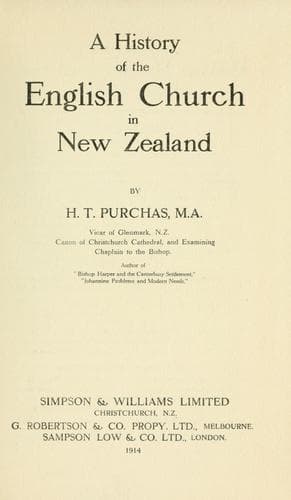
A History of the English Church in New ZealandPurchas, Henry Thomas
History
A History of the English Church in New Zealand
Purchas, Henry Thomas
Church of the Province of New Zealand -- History; New Zealand -- Church history
The authority in each diocese is shared by the bishop with his synod.
This body contains all the licensed clergy and an approximately equal
number of lay representatives. Its powers are considerable, but the days
when the synod was the arena of violent strife seem to be over. Good
feeling and harmonious co-operation between bishop, clergy, and laity
are now everywhere the rule.
The relations between bishop and clergy were rendered clearer by the
case of Dodwell v. the Bishop of Wellington in 1887. The old legal
status of an English "parson" was shown not to exist in New Zealand: no
clergyman has any position save such as is given him by the constitution
of the Church. In the same way, no parishioner has any claim at law
against his parish priest. This point was decided by the Avonside case
in 1889, where the action of a parishioner against the Rev. Canon
Pascoe, on the ground of a refusal of the Holy Communion, was disallowed
by the judge. The Church is free to do its own work in its own way, and
is bound only by such laws as it may think good to make for itself.
The supreme authority for the making of such laws is the General Synod,
of which the primate is president. This dignified body has hardly yet
developed that power and continuity of action which are required for
effective leadership. It suffers from smallness of numbers, from
infrequency of meetings, and from changes of locality. Attempts have
been made (notably in 1910) to strengthen the central authority by
conferring upon the primate the title of archbishop, in the hope that
the office might eventually be attached to one particular see, which
would thus become the ecclesiastical centre of the Province. Such
attempts have hitherto met with slight success. The country itself seems
to render centralisation difficult. If called upon to choose one of the
existing sees as the seat of the archbishopric, how would the synod
decide between Auckland with its traditions, Wellington with its
central position, and Christchurch with its cathedral and its
endowments? To ask the question is to show the difficulty of its answer.
By the fundamental provisions of its constitution the synod has no power
to alter the Prayer-Book. At every session this point is debated afresh,
with the only result of throwing up into clearer relief the
powerlessness of the synod with regard to it. Another matter which comes
up for regular treatment is the admission of women to a vote at parish
meetings. The measure has hitherto always been defeated by the vote of
the clerical order, but the tide seems now to have turned, as at least
two diocesan synods (those of Christchurch and Nelson) have passed
favouring resolutions by considerable majorities.
Public-domain text, read in full here on John Shaqi.
Reviews
Reviews
No reviews yet
Be the first to share your thoughts on this work.
Elsewhere in the archive
Join the Discussion
Join the discussion
Sign in to leave a comment or review.
Sign InorCreate an account