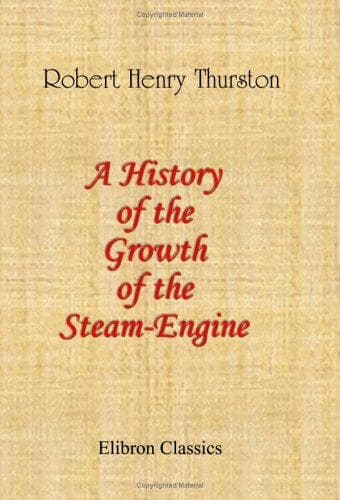
A History of the Growth of the Steam-EngineThurston, Robert Henry
History
A History of the Growth of the Steam-Engine
Thurston, Robert Henry
Steam-engines -- History
As early as 1830, Braithwaite and Ericsson, of London, England, built
an engine with steam and pump cylinders of 7 and 6-1/2 inches
diameter, respectively, with 16 inches stroke of piston. This machine
weighed 2-1/2 tons, and is said to have thrown 150 gallons of water
per minute to a height of between 80 and 100 feet. It was ready for
work in about 20 minutes after lighting the fire. Braithwaite
afterward supplied a more powerful engine to the King of Prussia, in
1832. The first attempt made in the United States to construct a steam
fire-engine was probably that of Hodge, who built one in New York in
1841. It was a strong and very effective machine, but was far too
heavy for rapid transportation. The late J. K. Fisher, who throughout
his life persistently urged the use of steam-carriages and
traction-engines, designing and building several, also planned a
steam fire-engine. Two were built from his design by the Novelty
Works, New York, about 1860, for Messrs. Lee & Larned. They were
"self-propellers," and one of them, built for the city of
Philadelphia, was sent to that city over the highway, driven by its
own engines. The other was built for and used by the New York Fire
Department, and did good service for several years. These engines were
heavy, but very powerful, and were found to move at good speed under
steam and to man[oe]uvre well. The Messrs. Latta, of Cincinnati, soon
after succeeded in constructing comparatively light and very effective
engines, and the fire department of that city was the first to adopt
steam fire-engines definitely as their principal reliance. This change
has now become general.
The steam fire-engine has now entirely displaced the old hand-engine
in all large cities. It does its work at a fraction of the cost of the
latter. It can force its water to a height of 225 feet, and to a
distance of more than 300 feet horizontally, while the hand-engine can
seldom throw it one-third these distances; and the "steamer" may be
relied upon to work at full power many hours if necessary, while the
men at the hand-engine soon become fatigued, and require frequent
relief. The city of New York has 40 steam fire-engines. One engine to
every 10,000 inhabitants is a proper proportion.
Public-domain text, read in full here on John Shaqi.
Reviews
Reviews
No reviews yet
Be the first to share your thoughts on this work.
Elsewhere in the archive
Join the Discussion
Join the discussion
Sign in to leave a comment or review.
Sign InorCreate an account