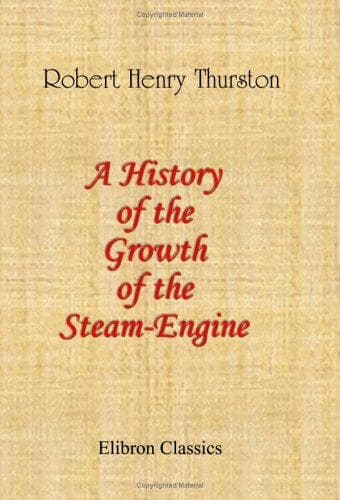
A History of the Growth of the Steam-EngineThurston, Robert Henry
History
A History of the Growth of the Steam-Engine
Thurston, Robert Henry
Steam-engines -- History
locomotive. The cost of passenger-locomotives of ordinary size is
about $12,000; heavier engines sometimes cost $20,000. The locomotive
is usually furnished with a tender, which carries its fuel and water.
The standard passenger-engine on the Pennsylvania Railroad has four
driving-wheels, 5-1/2 feet diameter; steam-cylinders, 17 inches
diameter and 2 feet stroke; grate-surface 15-1/2 square feet, and
heating-surface 1,058 square feet. It weighs 63,100 pounds, of which
39,000 pounds are on the drivers and 24,100 on the truck. The
freight-engine has six driving-wheels, 54-5/8 inches in diameter. The
steam-cylinders are 18 inches in diameter, stroke 22 inches,
grate-surface 14.8 square feet, heating-surface 1,096 feet. It weighs
68,500 pounds, of which 48,000 are on the drivers and 20,500 on the
truck. The former takes a train of five cars up an average grade of 90
feet to the mile. The latter is attached to a train of 11 cars. On a
grade of 50 feet to the mile, the former takes 7 and the latter 17
cars. Tank-engines for very heavy work, such as on grades of 320 feet
to the mile, which are found on some of the mountain lines of road,
are made with five pairs of driving-wheels, and with no truck. The
steam-cylinders are 20-1/8 inches in diameter, 2 feet stroke;
grate-area, 15-3/4 feet; heating-surface, 1,380 feet; weight with tank
full, and full supply of wood, 112,000 pounds; average weight, 108,000
pounds. Such an engine has hauled 110 tons up this grade at the speed
of 5 miles an hour, the steam-pressure being 145 pounds. The adhesion
was about 23 per cent. of the weight.
In checking a train in motion, the inertia of the engine itself
absorbs a seriously large portion of the work of the brakes. This is
sometimes reduced by reversing the engine and allowing the
steam-pressure to act in aid of the brakes. To avoid injury by
abrasion of the surfaces of piston, cylinder, and the valves and
valve-seats, M. Le Chatelier introduces a jet of steam into the
exhaust-passages when reversing, and thus prevents the ingress of
dust-laden air and the drying of the rubbing surfaces. This method of
checking a train is rarely resorted to, however, except in case of
danger. The introduction of the "continuous" or "air" brake, which can
be thrown into action in an instant on every car of the train by the
engine-driver, is so efficient that it is now almost universally
adopted. It is one of the most important safeguards which American
ingenuity has yet devised. In drawing a train weighing 150 tons at the
rate of 60 miles an hour, about 800 effective horse-power is required.
A speed of 80 miles an hour has been often attained, and 100 miles has
probably been reached.
Public-domain text, read in full here on John Shaqi.
Reviews
Reviews
No reviews yet
Be the first to share your thoughts on this work.
Elsewhere in the archive
Join the Discussion
Join the discussion
Sign in to leave a comment or review.
Sign InorCreate an account