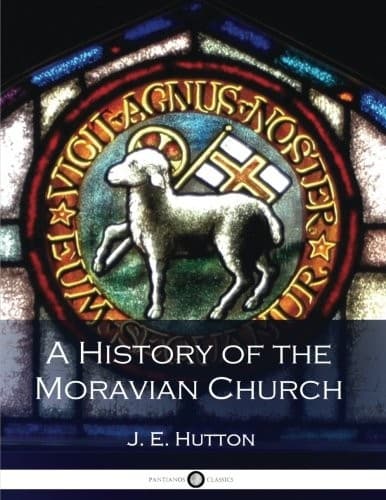
A History of the Moravian ChurchHutton, J. E. (Joseph Edmund)
Religion
A History of the Moravian Church
Hutton, J. E. (Joseph Edmund)
Moravian Church -- History
"My heart impelled me to come," he said; "to forsake my country and its
cause would have been sinning against my conscience. Here am I, my God,
do unto Thy servant as seemeth good unto Thee. I would rather die myself
than see my country die."
As he sat in his room on the Saturday evening--two days before the
execution--he was visited by two Capuchin monks. He was amazed at their
boldness. As they did not understand Bohemian, the conversation was
conducted in Latin. They informed him that their visit was one of pity.
"Of pity?" asked the white-haired old Baron, "How so?"
"We wish to show your lordship the way to heaven." He assured them that
he knew the way and stood on firm ground.
"My Lord only imagines," they rejoined, "that he knows the way of
salvation. He is mistaken. Not being a member of the Holy Church, he has
no share in the Church's salvation."
But Budowa placed his trust in Christ alone.
"I have this excellent promise," he said, "Whosoever believeth in Him
shall not perish but have everlasting life. Therefore, until my last
moment, will I abide by our true Church."
Thus did Budowa declare the faith of the Brethren. The Capuchin monks
were horrified. They smote their breasts, declared that so hardened a
heretic they had never seen, crossed themselves repeatedly, and left him
sadly to his fate.
For the last time, on the Monday morning, he was given another chance to
deny his faith. Two Jesuits came to see him.
"We have come to save my lord's soul," they said, "and to perform a work
of mercy."
"Dear fathers," replied Budowa, "I thank my God that His Holy Spirit
has given me the assurance that I will be saved through the blood of
the Lamb." He appealed to the words of St. Paul: "I know whom I have
believed: henceforth there is laid up for me a crown of righteousness,
which the Lord, the righteous judge, shall give me at that day."
"But," said the Jesuits, "Paul there speaks of himself, not of others."
"You lie," said Budowa, "for does he not expressly add: 'and not to me
only, but unto all them also that love his appearing.'"
And after a little more argumentation, the Jesuits left in disgust.
The last moment in Budowa's life now arrived. The messenger came and
told him it was his turn to die. He bade his friends farewell.
"I go," he declared, "in the garment of righteousness; thus arrayed
shall I appear before God."
Alone, with firm step he strode to the scaffold, stroking proudly his
silver hair and beard.
"Thou old grey head of mine," said he, "thou art highly honoured; thou
shalt be adorned with the Martyr-Crown."
As he knelt and prayed he was watched by the pitying eyes of the two
kind-hearted Jesuits who had come to see him that morning. He prayed for
his country, for his Church, for his enemies, and committed his soul
to Christ; the sword flashed brightly in the sun; and one strong
blow closed the restless life of Wenzel von Budowa, the "Last of the
Bohemians."
Public-domain text, read in full here on John Shaqi.
Reviews
Reviews
No reviews yet
Be the first to share your thoughts on this work.
Elsewhere in the archive
Join the Discussion
Join the discussion
Sign in to leave a comment or review.
Sign InorCreate an account