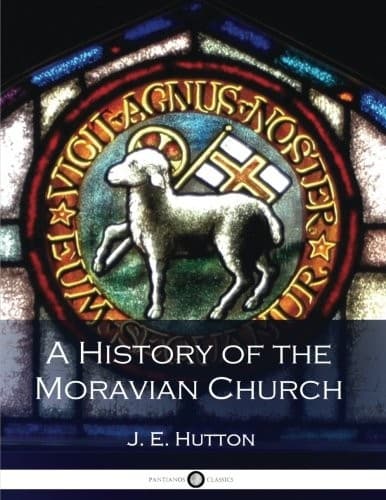
A History of the Moravian ChurchHutton, J. E. (Joseph Edmund)
Religion
A History of the Moravian Church
Hutton, J. E. (Joseph Edmund)
Moravian Church -- History
at all severe punishment should be reserved for moral offences only.
"The whole object of discipline," he said, "is to form in those
committed to our charge a disposition worthy of the children of God."
He believed, in a word, in the teaching of religion in day-schools; he
believed in opening school with morning prayers, and he held that all
scholars should be taught to say passages of Scripture by heart, to sing
psalms, to learn a Catechism and to place their trust in the salvation
offered through Jesus Christ. And yet Comenius did not insist on the
teaching of any definite religious creed. He belonged himself to a
Church that had no creed; he took a broader view of religion than either
the Lutherans or the Calvinists; he believed that Christianity could be
taught without a formal dogmatic statement; and thus, if I understand
him aright, he suggested a solution of a difficult problem which baffles
our cleverest politicians to-day.
Again Comenius introduced a new way of learning languages. His great
work on this subject was entitled "Janua Linguarum Reserata"--i.e., The
Gate of Languages Unlocked. Of all his works this was the most popular.
It spread his fame all over Europe. It was translated into fifteen
different languages. It became, next to the Bible, the most widely
known book on the Continent. For one person who read his delightful
"Labyrinth," there were thousands who nearly knew the "Janua" by heart.
The reason was obvious. The "Labyrinth" was a religious book, and was
suppressed as dangerous by Catholic authorities; but the "Janua" was
only a harmless grammar, and could be admitted with safety anywhere. It
is not the works of richest genius that have the largest sale; it is
the books that enable men to get on in life; and the "Janua" was popular
because, in truth, "it supplied a long-felt want." It was a Latin
grammar of a novel and original kind. For all boys desiring to enter a
profession a thorough knowledge of Latin was then an absolute necessity.
It was the language in which the learned conversed, the language spoken
at all Universities, the language of diplomatists and statesmen, the
language of scientific treatises. If a man could make the learning of
Latin easier, he was adored as a public benefactor. Comenius's Grammar
was hailed with delight, as a boon and a blessing to men. For years
all patient students of Latin had writhed in agonies untold. They
had learned long lists of Latin words, with their meanings; they had
wrestled in their teens with gerunds, supines, ablative absolutes and
distracting rules about the subjunctive mood, and they had tried in vain
to take an interest in stately authors far above their understanding.
Comenius reversed the whole process. What is the use, he asked, of
learning lists of words that have no connection with each other? What is
the use of teaching a lad grammar before he has a working knowledge of
the language? What is the use of expecting a boy to take an interest in
Public-domain text, read in full here on John Shaqi.
Reviews
Reviews
No reviews yet
Be the first to share your thoughts on this work.
Elsewhere in the archive
Join the Discussion
Join the discussion
Sign in to leave a comment or review.
Sign InorCreate an account