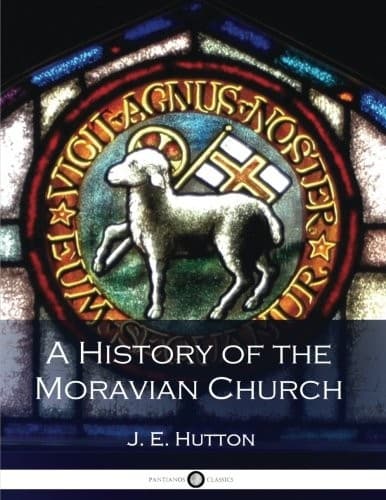
A History of the Moravian ChurchHutton, J. E. (Joseph Edmund)
Religion
A History of the Moravian Church
Hutton, J. E. (Joseph Edmund)
Moravian Church -- History
For eight years the Brethren, undaunted still, held on together as best
they could at Lissa; and Comenius, now their chosen leader, made a brave
attempt to revive their schools in Hungary. And then came the final,
awful crash. The flames of war burst out afresh. When Charles X. became
King of Sweden, John Casimir, King of Poland, set up a claim to the
Swedish throne. The two monarchs went to war. Charles X. invaded Poland;
John Casimir fled from Lissa; Charles X. occupied the town. What part,
it may be asked, did the Brethren play in this war? We do not know. As
Charles X. was, of course, a Protestant, it is natural to assume that
the Brethren sympathised with his cause and hailed him as a deliverer
sent by God; but it is one of the strangest features of their history
that we never can tell what part they took in these political conflicts.
Comenius was now in Lissa. It is said that he openly sided with Charles
X., and urged the Brethren to hold out to the bitter end. I doubt it.
For a while the Swedish army triumphed. In that army was an old Bohemian
general, who swore to avenge the "Day of Blood"; and the churches and
convents were plundered, and monks and priests were murdered. For a
moment the Day of Blood was avenged, but for a moment only. As the arm
of flesh had failed the Brethren in the days of Budowa, so the arm of
flesh failed them now.
The Polish army surrounded the walls of Lissa {1656.}. A panic broke out
among the citizens. The Swedish garrison gave way. The Polish soldiers
pressed in. Again Comenius's library was burned, and the grammar school
where he had taught was reduced to ashes. The whole town was soon in
flames. The fire spread for miles in the surrounding country. As the
Brethren fled from their last fond home, with the women and children
huddled in waggons, they saw barns and windmills flaring around them,
and heard the tramp of the Polish army in hot pursuit. As Pastor John
Jacobides and two Acoluths were on their way to Karmin, they were
seized, cut down with spades and thrown into a pit to perish. For Samuel
Kardus, the last martyr of the fluttering fragment, a more ingenious
torture was reserved. He was placed with his head between a door and the
door-post, and as the door was gently but firmly closed, his head was
slowly crushed to pieces.
Public-domain text, read in full here on John Shaqi.
Reviews
Reviews
No reviews yet
Be the first to share your thoughts on this work.
Elsewhere in the archive
Join the Discussion
Join the discussion
Sign in to leave a comment or review.
Sign InorCreate an account