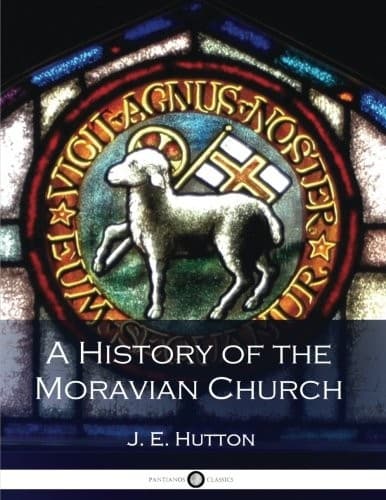
A History of the Moravian ChurchHutton, J. E. (Joseph Edmund)
Religion
A History of the Moravian Church
Hutton, J. E. (Joseph Edmund)
Moravian Church -- History
But, thirdly, and most important of all, Comenius kept the old faith
burning in the hearts of the "Hidden Seed." For the benefit of those
still worshipping in secret in Bohemia and Moravia, he prepared a
Catechism, entitled "The Old Catholic Christian Religion in Short
Questions and Answers"; and by this Catholic Religion he meant the
broad and simple faith of the Bohemian Brethren. "Perish sects," said
Comenius; "perish the founders of sects. I have consecrated myself to
Christ alone." But the purpose of the Catechism had to be kept a secret.
"It is meant," said Comenius, in the preface, "for all the pious and
scattered sheep of Christ, especially those at F., G., G., K., K., S.,
S. and Z." These letters can be easily explained. They stood for
the villages of Fulneck, Gersdorf, Gestersdorf, Kunewalde, Klandorf,
Stechwalde, Seitendorf and Zauchtenthal; and these are the places from
which the first exiles came to renew the Brethren's Church at Herrnhut.
Fifty years before his prayers were answered, Comenius lay silent in
the grave (1672). Yet never did bread cast upon the waters more richly
return.
SUPPLEMENTARY NOTE.
THE BOHEMIAN BRETHREN AND THE CHURCH OF ENGLAND.
As the relations of the Brethren with England were only of a very
occasional nature, it is not easy to weave them into the narrative. But
the following particulars will be of special interest; they show the
opinion held of the Brethren by officials of the Church of England:--
1. The case of John Bernard.--At some period in the reign of Queen
Elizabeth a number of scholarships were founded at Oxford for the
benefit of Bohemian students; and in 1583 John Bernard, a Moravian
student, took his B.D. degree at Oxford. The record in the University
Register is as follows: "Bernardus, John, a Moravian, was allowed
to supply B.D. He had studied theology for ten years at German
Universities, and was now going to the Universities of Scotland." This
proves that the University of Oxford recognised Bernard as a man in holy
orders; for none but men in holy orders could take the B.D. degree.
Public-domain text, read in full here on John Shaqi.
Reviews
Reviews
No reviews yet
Be the first to share your thoughts on this work.
Elsewhere in the archive
Join the Discussion
Join the discussion
Sign in to leave a comment or review.
Sign InorCreate an account