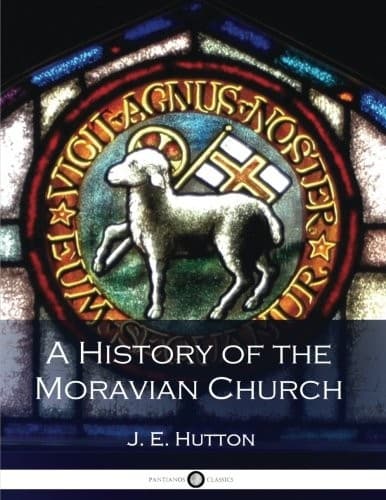
A History of the Moravian ChurchHutton, J. E. (Joseph Edmund)
Religion
A History of the Moravian Church
Hutton, J. E. (Joseph Edmund)
Moravian Church -- History
He was born at six o'clock in the evening, Wednesday, May 26th, 1700, in
the picturesque city of Dresden {1700.}; the house is pointed out to the
visitor; and "Zinzendorf Street" reminds us still of the noble family
that has now died out. He was only six weeks old when his father burst
a blood-vessel and died; he was only four years when his mother married
again; and the young Count--Nicholas Lewis, Count of Zinzendorf and
Pottendorf--was handed over to the tender care of his grandmother,
Catherine von Gersdorf, who lived at Gross-Hennersdorf Castle. And now,
even in childhood's days, little Lutz, as his grandmother loved to call
him, began to show signs of his coming greatness. As his father lay on
his dying bed, he had taken the child in his feeble arm, and consecrated
him to the service of Christ; and now in his grandmother's noble home he
sat at the feet of the learned, the pious, and the refined. Never was a
child less petted and pampered; never was a child more strictly trained;
never was a child made more familiar with the person and teaching of
Jesus Christ. Dr. Spener,[58] the famous Pietist leader, watched his
growth with fatherly interest. The old lady was a leader in Pietist
circles, was a writer of beautiful religious poetry, and guarded him as
the apple of her eye. He read the Bible every day. He doted on Luther's
Catechism. He had the Gospel story at his finger-ends. His aunt
Henrietta, who was rather an oddity, prayed with him morning and night.
His tutor, Edeling, was an earnest young Pietist from Franke's school at
Halle; and the story of Zinzendorf's early days reads like a mediaeval
tale. "Already in my childhood," he says, {1704.} "I loved the Saviour,
and had abundant communion with Him. In my fourth year I began to seek
God earnestly, and determined to become a true servant of Jesus Christ."
At the age of six he regarded Christ as his Brother, would talk with Him
for hours together as with a familiar friend and was often found rapt in
thought {1706.}, like Socrates in the market-place at Athens. As other
children love and trust their parents, so this bright lad with the
golden hair loved and trusted Christ. "A thousand times," he said, "I
heard Him speak in my heart, and saw Him with the eye of faith." Already
the keynote of his life was struck; already the fire of zeal burned in
his bosom. "Of all the qualities of Christ," said He, "the greatest is
His nobility; and of all the noble ideas in the world, the noblest is
the idea that the Creator should die for His children. If the Lord were
forsaken by all the world, I still would cling to Him and love Him."
He held prayer-meetings in his private room. He was sure that Christ
Himself was present there. He preached sermons to companies of friends.
If hearers failed, he arranged the chairs as an audience; and still is
shown the little window from which he threw letters addressed to Christ,
not doubting that Christ would receive them. As the child was engaged
Public-domain text, read in full here on John Shaqi.
Reviews
Reviews
No reviews yet
Be the first to share your thoughts on this work.
Elsewhere in the archive
Join the Discussion
Join the discussion
Sign in to leave a comment or review.
Sign InorCreate an account