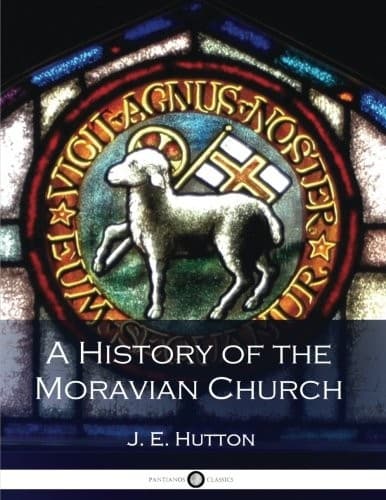
A History of the Moravian ChurchHutton, J. E. (Joseph Edmund)
Religion
A History of the Moravian Church
Hutton, J. E. (Joseph Edmund)
Moravian Church -- History
The time of deliverance had come. As Christian David heard of the
sufferings which these men had now to endure, his blood boiled with
anger. He resolved to go to their rescue. The path lay open. He had
made many friends in Saxony. His friend Schäfer introduced him to Rothe;
Rothe introduced him to Zinzendorf; and Christian David asked the Count
for permission to bring some persecuted Protestants from Moravia to find
a refuge in Berthelsdorf. The conversation was momentous. The heart of
the Count was touched. If these men, said he, were genuine martyrs, he
would do his best to help them; and he promised David that if they came
he would find them a place of abode. The joyful carpenter returned to
Moravia, and told the news to the Neisser family at Sehlen. "This," said
they, "is God's doing; this is a call from the Lord."
And so, at ten o'clock one night, there met at the house of Jacob
Neisser, in Sehlen, a small band of emigrants {May 27th, 1722.}. At the
head of the band was Christian David; and the rest of the little group
consisted of Augustin and Jacob Neisser, their wives and children,
Martha Neisser, and Michael Jaeschke, a cousin of the family.[72] We know
but little about these humble folk; and we cannot be sure that they were
all descendants of the old Church of the Brethren. Across the mountains
they came, by winding and unknown paths. For the sake of their faith
they left their goods and chattels behind; long and weary was the march;
and at length, worn out and footsore, they arrived, with Christian David
at their head, at Zinzendorf's estate at Berthelsdorf {June 8th, 1722.}.
The streams had met: the new river was formed; and thus the course of
Renewed Brethren's History had begun.
CHAPTER III. -- THE FOUNDING OF HERRNHUT, 1722-1727.
As these wanderers from a foreign land had not been able to bring
in their pockets certificates of orthodoxy, and might, after all, be
dangerous heretics, it occurred to Zinzendorf's canny steward, Heitz,
that on the whole it would be more fitting if they settled, not in the
village itself, but at a safe and convenient distance. The Count was
away; the steward was in charge; and the orthodox parish must not be
exposed to infection. As the Neissers, further, were cutlers by trade,
there was no need for them in the quiet village. If they wished to earn
an honest living they could do it better upon the broad high road.
Public-domain text, read in full here on John Shaqi.
Reviews
Reviews
No reviews yet
Be the first to share your thoughts on this work.
Elsewhere in the archive
Join the Discussion
Join the discussion
Sign in to leave a comment or review.
Sign InorCreate an account