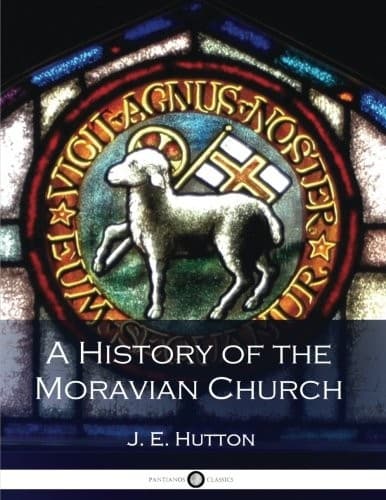
A History of the Moravian ChurchHutton, J. E. (Joseph Edmund)
Religion
A History of the Moravian Church
Hutton, J. E. (Joseph Edmund)
Moravian Church -- History
"What! a parson!" quoth another. "Why, the poor fool must have lost his
head."
They argued the case; they mocked; they laughed; they found the subject
intensely amusing.
"And what, sir, do you think?" said a waiter to Schmidt, who was sitting
quietly in the corner.
"I am the very man," replied Schmidt; and the farmers began to talk
about their crops.
For six years George Schmidt laboured all alone among the benighted
Hottentots. He began his labours at a military outpost in the Sweet-Milk
Valley, about fifty miles east of Cape Town; but finding the company
of soldiers dangerous to the morals of his congregation, he moved to a
place called Bavian's Kloof, where the town of Genadendal stands to-day.
He planted the pear-tree so famous in missionary annals, taught the
Hottentots the art of gardening, held public service every evening, had
fifty pupils in his day-school, and began to baptize his converts. As he
and William, one of his scholars, were returning one day from a visit to
Cape Town, they came upon a brook, and Schmidt asked William if he had a
mind to be baptized there and then. He answered "Yes." And there, by
the stream in a quiet spot, the first fruit of African Missions made his
confession of faith in Christ.
"Dost thou believe," asked Schmidt solemnly, "that the Son of God died
on the cross for the sins of all mankind? Dost thou believe that thou
art by nature a lost and undone creature? Wilt thou renounce the devil
and all his works? Art thou willing, in dependence on God's grace, to
endure reproach and persecution, to confess Christ before all men, and
to remain faithful to him unto death?"
As soon, however, as Schmidt began to baptize his converts the Cape Town
clergy denounced him as a heretic, and summoned him to answer for his
sins. The great charge against him was that he had not been properly
ordained. He had been ordained, not by actual imposition of hands, but
by a certificate of ordination, sent out to him by Zinzendorf. To the
Dutch clergy this was no ordination at all. What right, said they, had
a man to baptize who had been ordained in this irregular manner? He
returned to Holland to fight his battle there. And he never set foot on
African soil again! The whole argument about the irregular ordination
turned out to be a mere excuse. If that argument had been genuine the
Dutch clergy could now have had Schimdt ordained in the usual way. But
the truth is they had no faith in his mission; they had begun to regard
the Brethren as dangerous heretics; and, therefore, for another fifty
years they forbade all further mission work in the Dutch Colony of South
Africa.
Public-domain text, read in full here on John Shaqi.
Reviews
Reviews
No reviews yet
Be the first to share your thoughts on this work.
Elsewhere in the archive
Join the Discussion
Join the discussion
Sign in to leave a comment or review.
Sign InorCreate an account