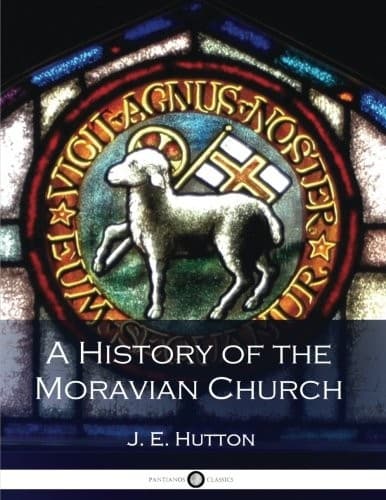
A History of the Moravian ChurchHutton, J. E. (Joseph Edmund)
Religion
A History of the Moravian Church
Hutton, J. E. (Joseph Edmund)
Moravian Church -- History
But how was this universal experience to be attained? The Count had
his answer ready. He had studied the philosophical works of Spinoza and
Bayle. He was familiar with the trend of the rationalistic movement. He
was aware that to thousands, both inside and outside the Church, the
God whom Jesus called "Our Father" was no more than a cold philosophical
abstraction; and that many pastors in the Lutheran Church, instead
of trying to make God a reality, were wasting their time in spinning
abstruse speculations, and discussing how many legions of angels could
stand on the point of a needle. As this sort of philosophy rather
disgusted Zinzendorf, he determined to frame a theology of his own; and
thereby he arrived at the conclusion that the only way to teach men to
love God was "to preach the Creator of the World under no other shape
than that of a wounded and dying Lamb." He held that the Suffering
Christ on the Cross was the one perfect expression and revelation of the
love of God; he held that the title "Lamb of God" was the favourite name
for Christ in the New Testament; he held that the central doctrine of
the faith was the "Ransom" paid by Christ in His sufferings and death;
and, therefore, he began to preach himself, and taught his Brethren to
preach as well, the famous "Blood and Wounds Theology."
And now, at a Synod held in London, the Brethren cleared the decks
for action, and took their stand on the stage of history as a free,
independent Church of Christ {1741.}. The situation was alarming. Of all
the Protestant Churches in Europe, the Church of the Brethren was the
broadest in doctrine and the most independent in action; and yet, during
the last few years, the Brethren were actually in danger of bending the
knee to a Pope. The Pope in question was Leonard Dober. At the time
when Herrnhut was founded, the Brethren had elected a governing board of
twelve Elders. Of these twelve Elders, four Over-Elders were set apart
for spiritual purposes; and of these four Over-Elders, one was specially
chosen as Chief Elder. The first Chief Elder was Augustin Neisser, and
the second Martin Linner. As long as the office lay in Linner's hands,
there was no danger of the Chief Elder becoming a Pope. He was poor; he
was humble; he was weak in health; and he spent his time in praying for
the Church and attending to the spiritual needs of the Single Brethren.
But gradually the situation altered. For the last six years the office
had been held by Leonard Dober. He had been elected by Lot, and was,
therefore, supposed to possess Divine authority. He was General Elder
of the whole Brethren's Church. He had become the supreme authority in
spiritual matters. He had authority over Zinzendorf himself, over all
the Bishops, over all the members of the Pilgrim Band, over all Moravian
Brethren at Herrnhut, over the pioneers in England and North America,
over the missionaries in Greenland, the West Indies, South Africa and
Surinam. He had become a spiritual referee.
Public-domain text, read in full here on John Shaqi.
Reviews
Reviews
No reviews yet
Be the first to share your thoughts on this work.
Elsewhere in the archive
Join the Discussion
Join the discussion
Sign in to leave a comment or review.
Sign InorCreate an account