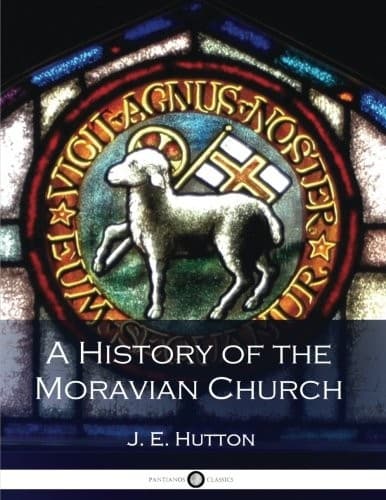
A History of the Moravian ChurchHutton, J. E. (Joseph Edmund)
Religion
A History of the Moravian Church
Hutton, J. E. (Joseph Edmund)
Moravian Church -- History
And now there was only one more step to take. As soon as the Synod in
London was over, Count Zinzendorf set off for America in pursuit of a
scheme to be mentioned in its proper place; and as soon as he was safely
out of the way, the Brethren at home set about the task of obtaining
recognition by the State. They had an easy task before them. For the
last ninety-four years--ever since the Peace of Westphalia (1648)--the
ruling principle in German had been that each little king and each
little prince should settle what the religion should be in his own
particular dominions. If the King was a Lutheran, his people must be
Lutheran; if the King was Catholic, his people must be Catholic. But now
this principle was suddenly thrown overboard. The new King of Prussia,
Frederick the Great, was a scoffer. For religion Frederick the Great
cared nothing; for the material welfare of his people he cared a good
deal. He had recently conquered Silesia; he desired to see his land
well tilled, and his people happy and good; and, therefore, he readily
granted the Brethren a "Concession," allowing them to settle in Prussia
and Silesia {Dec. 25th, 1742.}. His attitude was that of the practical
business man. As long as the Brethren obeyed the law, and fostered
trade, they could worship as they pleased. For all he cared, they might
have prayed to Beelzebub. He granted them perfect liberty of conscience;
he allowed them to ordain their own ministers; he informed them that
they would not be subject to the Lutheran consistory; and thus, though
not in so many words, he practically recognized the Brethren as a free
and independent Church. For the future history of the Brethren's Church,
this "Concession" was of vast importance. In one sense it aided their
progress; in another it was a fatal barrier. As the Brethren came to
be known as good workmen, other magnates speedily followed the king's
example; for particular places particular "concessions" were prepared;
and thus the Brethren were encouraged to extend their "settlement
system." Instead, therefore, of advancing from town to town, the
Brethren concentrated their attention on the cultivation of settlement
life; and before many years had passed away they had founded settlements
at Niesky, Gnadenberg, Gnadenfrei, and Neusalz-on-the-Oder.
Thus, then, had the Brethren sketched the plan of all their future work.
They had regained their episcopal orders. They had defined their mission
in the world. They had chosen their Gospel message. They had asserted
their freedom of thought. They had won the goodwill of the State. They
had adopted the "settlement system." They had begun their Diaspora work
for the scattered, and their mission work for the heathen; and thus
they had revived the old Church of the Brethren, and laid down those
fundamental principles which have been maintained down to the present
day.
Public-domain text, read in full here on John Shaqi.
Reviews
Reviews
No reviews yet
Be the first to share your thoughts on this work.
Elsewhere in the archive
Join the Discussion
Join the discussion
Sign in to leave a comment or review.
Sign InorCreate an account