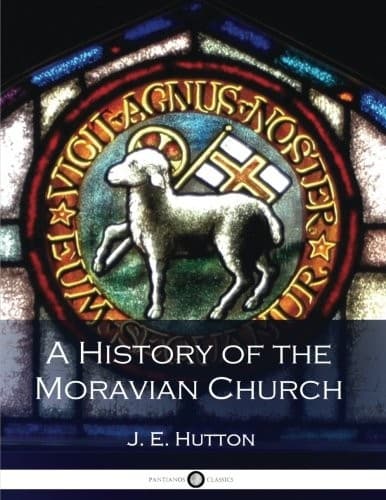
A History of the Moravian ChurchHutton, J. E. (Joseph Edmund)
Religion
A History of the Moravian Church
Hutton, J. E. (Joseph Edmund)
Moravian Church -- History
little wound-parsons, cross-wood little splinters, a blessed troop of
cross-air[102] birds, cross-air little atoms, cross-air little sponges,
and cross-air little pigeons.
The chief sinner was the Count himself. Having thrown his common
sense overboard, he gave free rein to his fancy, and came out with an
exposition of the Holy Trinity which offended the rules of good taste.
He compared the Holy Trinity to a family. The father, said he, was God;
the mother was the Holy Ghost; their son was Jesus; and the Church of
Christ, the Son's fair bride, was born in the Saviour's Side-wound,
was betrothed to Christ on the Cross, was married to Christ in the Holy
Communion, and was thus the daughter-in-law of the Father and the Holy
Ghost. We can all see the dangers of this. As soon as human images
of spiritual truths are pressed beyond decent limits, they lead to
frivolity and folly; and that was just the effect at Herrnhaag. The more
freely the Brethren used these phrases, the more childish they became.
They called the Communion the "Embracing of the Man"; and thus they lost
their reverence for things Divine.
But the next move of the Count was even worse. For its origin we must go
back a few years in his story. As the Count one day was burning a pile
of papers he saw one slip flutter down to the ground untouched by the
fire {1734.}. He picked it up, looked at it, and found that it contained
the words:--
"Oh, let us in Thy nail-prints see
Our pardon and election free."
At first the effect on Zinzendorf was healthy enough. He regarded the
words as a direct message from God. He began to think more of the value
of the death of Christ. He altered the style of his preaching; he became
more definitely evangelical; and henceforth he taught the doctrine that
all happiness and all virtue must centre in the atoning death of Christ.
"Since the year 1734," he said, "the atoning sacrifice of Jesus became
our only testimony and our one means of salvation." But now he carried
this doctrine to excess. Again the cause was his use of the Lot. As long
as Zinzendorf used his own mental powers, he was able to make his "Blood
and Wounds Theology" a power for good; but as soon as he bade good-bye
to his intellect he made his doctrine a laughing-stock and a scandal.
Instead of concentrating his attention on the moral and spiritual value
of the cross, he now began to lay all the stress on the mere physical
details. He composed a "Litany of the Wounds"; and the Brethren could
now talk and sing of nothing else {1743.}. "We stick," they said, "to
the Blood and Wounds Theology. We will preach nothing but Jesus the
Crucified. We will look for nothing else in the Bible but the Lamb and
His Wounds, and again Wounds, and Blood and Blood." Above all they began
to worship the Side-wound. "We stick," they declared, "to the Lambkin
and His little Side-wound. It is useless to call this folly. We dote
upon it. We are in love with it. We shall stay for ever in the little
Public-domain text, read in full here on John Shaqi.
Reviews
Reviews
No reviews yet
Be the first to share your thoughts on this work.
Elsewhere in the archive
Join the Discussion
Join the discussion
Sign in to leave a comment or review.
Sign InorCreate an account