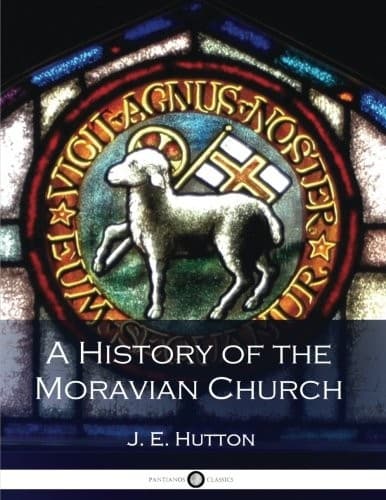
A History of the Moravian ChurchHutton, J. E. (Joseph Edmund)
Religion
A History of the Moravian Church
Hutton, J. E. (Joseph Edmund)
Moravian Church -- History
As Wesley listened to these discussions he grew impatient and
disgusted. The whole tone of the Society was distasteful to his mind.
If ever a man was born to rule it was Wesley; and here, at Fetter Lane,
instead of being captain, he was merely one of the crew, and could not
even undertake a journey without the consent of the Society. The fetters
were beginning to gall.
At this point there arrived from Germany a strange young man on his way
to America, who soon added fuel to the fire {Oct. 18th, 1739.}. His
name was Philip Henry Molther. He was only twenty-five years old; he had
belonged to the Brethren's Church about a year; he had spent some months
as tutor in Zinzendorf's family; he had picked up only the weak side
of the Brethren's teaching; and now, with all the zeal of youth, he set
forth his views in extravagant language, which soon filled Wesley with
horror. His power in the Society was immense, and four times a week, in
broken English, he preached to growing crowds. At first he was utterly
shocked by what he saw. "The first time I entered the meeting," he says,
"I was alarmed and almost terror-stricken at hearing their sighing and
groaning, their whining and howling, which strange proceeding they call
the demonstration of the Spirit and of power." For these follies Molther
had a cure of his own. He called it "stillness." As long as men were
sinners, he said, they were not to try to obtain saving faith by any
efforts of their own. They were not to go to church. They were not to
communicate. They were not to fast. They were not to use so much private
prayer. They were not to read the Scriptures. They were not to do either
temporal or spiritual good. Instead of seeking Christ in these ways,
said Molther, the sinner should rather sit still and wait for Christ to
give him the Divine revelation. If this doctrine had no other merit
it had at least the charm of novelty. The dispute at Fetter Lane grew
keener than ever. On the one hand Hutton, James Bell, John Bray, and
other simple-minded men regarded Molther as a preacher of the
pure Gospel. He had, said Hutton, drawn men away from many a false
foundation, and had led them to the only true foundation, Christ. "No
soul," said another, "can be washed in the blood of Christ unless it
first be brought to one in whom Christ is fully formed. But there are
only two such men in London, Bell and Molther." John Bray, the brazier,
went further.
"It is impossible," he said, "for anyone to be a true Christian outside
the Moravian Church."
Public-domain text, read in full here on John Shaqi.
Reviews
Reviews
No reviews yet
Be the first to share your thoughts on this work.
Elsewhere in the archive
Join the Discussion
Join the discussion
Sign in to leave a comment or review.
Sign InorCreate an account