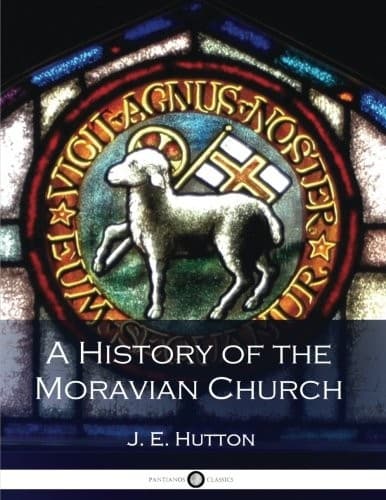
A History of the Moravian ChurchHutton, J. E. (Joseph Edmund)
Religion
A History of the Moravian Church
Hutton, J. E. (Joseph Edmund)
Moravian Church -- History
For good or for evil that settlement system was soon the leading feature
of the English work. The building of Fulneck began. First the Brethren
called the place Lamb's Hill, then Gracehall, and then Fulneck, in
memory of Fulneck in Moravia. From friends in Germany they received
gifts in money, from friends in Norway a load of timber. The Single
Brethren were all aglow with zeal; and on one occasion they spent the
whole night in saying prayers and singing hymns upon the chosen sites.
First rose the Chapel (1746), then the Minister's House and the rooms
beneath and just to the east of the Chapel (1748), then the Brethren's
and Sisters' Houses (1752), then the Widows' House (1763), then the
Shop and Inn (1771), then the Cupola (1779), and then the Boys' Boarding
School (1784-5). Thus, step by step, the long line of buildings arose, a
sight unlike any other in the United Kingdom.
As the Brethren settled down in that rough Yorkshire country, they had
a noble purpose, which was a rebuke to the godless and cynical spirit
of the age. "Is a Christian republic possible?" asked the French
philosopher, Bayle. According to the world it was not; according to the
Brethren it was; and here at Fulneck they bravely resolved to put the
matter to the proof. As long as that settlement existed, said they,
there would be a kingdom where the law of Christ would reign supreme,
where Single Brethren, Single Sisters, and Widows, would be screened
from the temptations of the wicked world, where candidates would
be trained for the service of the Church and her Master, where
missionaries, on their way to British Colonies, could rest awhile, and
learn the English language, where children, in an age when schools were
scarce, could be brought up in the fear of God, and where trade would
be conducted, not for private profit, but for the benefit of all. At
Fulneck, in a word, the principles of Christ would be applied to the
whole round of Moravian life. There dishonesty would be unknown; cruel
oppression would be impossible; doubtful amusements would be forbidden;
and thus, like their German Brethren in Herrnhut, these keen and hardy
Yorkshire folk were to learn by practical experience that it is more
blessed to give than to receive, and more delightful to work for a
common cause than for a private balance at the bank.
Public-domain text, read in full here on John Shaqi.
Reviews
Reviews
No reviews yet
Be the first to share your thoughts on this work.
Elsewhere in the archive
Join the Discussion
Join the discussion
Sign in to leave a comment or review.
Sign InorCreate an account