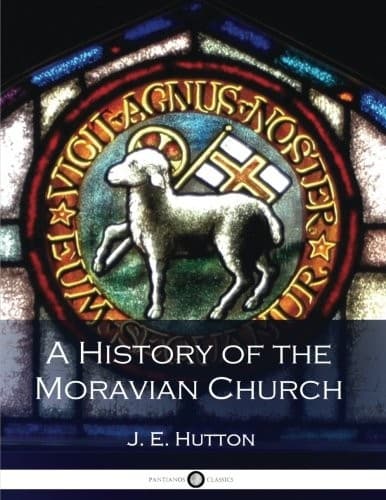
A History of the Moravian ChurchHutton, J. E. (Joseph Edmund)
Religion
A History of the Moravian Church
Hutton, J. E. (Joseph Edmund)
Moravian Church -- History
But the most striking feature of the settlement system is still to
be mentioned. It was the road, not to Church extension, but to Church
extinction. If the chief object which the Brethren set before them was
to keep that Church as small as possible, they could hardly have adopted
a more successful method. We may express that method in the one word
"centralization." For years the centre of the Yorkshire work was
Fulneck. At Fulneck met the Elders' Conference. At Fulneck all Choir
Festivals were held; at these Festivals the members from the other
congregations were expected to be present; and when John de Watteville
arrived upon the scene (1754) he laid down the regulation that although
in future there were to be "as many congregations as chapels in
Yorkshire," yet all were still to be one body, and all members must
appear at Fulneck at least once a quarter! At Fulneck alone--in these
earlier years--did the Brethren lay out a cemetery; and in that cemetery
all funerals were to be conducted. The result was inevitable. As long as
the other congregations were tied to the apron strings of Fulneck they
could never attain to independent growth. I give one instance to show
how the system worked. At Mirfield a young Moravian couple lost a child
by death. As the season was winter, and the snow lay two feet deep, they
could not possibly convey the coffin to Fulneck; and therefore they had
the funeral conducted by the Vicar at Mirfield. For this sin they were
both expelled from the Moravian Church. At heart, in fact, these early
Brethren had no desire for Moravian Church extension whatever. They
never asked anyone to attend their meetings, and never asked anyone to
join their ranks. If any person expressed a desire to become a member
of the Moravian Church, he was generally told in the first instance "to
abide in the Church of England"; and only when he persisted and begged
was his application even considered. And even then they threw obstacles
in his way. They first submitted his application to the Lot. If the Lot
said "No," he was rejected, and informed that the Lord did not wish him
to join the Brethren's Church. If the Lot said "Yes," he had still a
deep river to cross. The "Yes" did not mean that he was admitted; it
only meant that his case would be considered. He was now presented with
a document called a "testimonial," informing him that his application
was receiving attention. He had then to wait two years; his name was
submitted to the Elders' Conference; the Conference inquired into all
his motives, and put him through a searching examination; and at the end
of the two years he was as likely to be rejected as accepted. For these
rules the Brethren had one powerful reason of their own. They had no
desire to steal sheep from the Church of England. At the very outset
of their campaign they did their best to make their position clear. "We
wish for nothing more," they declared, in a public notice in the Daily
Public-domain text, read in full here on John Shaqi.
Reviews
Reviews
No reviews yet
Be the first to share your thoughts on this work.
Elsewhere in the archive
Join the Discussion
Join the discussion
Sign in to leave a comment or review.
Sign InorCreate an account