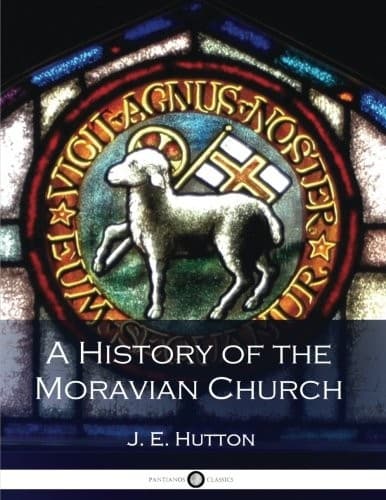
A History of the Moravian ChurchHutton, J. E. (Joseph Edmund)
Religion
A History of the Moravian Church
Hutton, J. E. (Joseph Edmund)
Moravian Church -- History
Another cause of trouble was the Moravian religious language. If the
Brethren did not preach novel doctrines they certainly preached old
doctrines in a novel way. They called Jesus the Man of Smart; talked a
great deal about Blood and Wounds; spoke of themselves as Poor Sinners;
and described their own condition as Sinnership and Sinnerlikeness. To
the orthodox Churchman this language seemed absurd. He did not know what
it meant; he did not find it in the Bible; and, therefore, he concluded
that the Brethren's doctrine was unscriptural and unsound.
Another cause of trouble was the Brethren's doctrine of justification
by faith alone. Of all the charges brought against them the most serious
and the most persistent was the charge that they despised good works.
They were denounced as Antinomians. Again and again, by the best of men,
this insulting term was thrown at their heads. They taught, it was said,
the immoral doctrine that Christ had done everything for the salvation
of mankind; that the believer had only to believe; that he need not
obey the commandments; and that such things as duties did not exist.
At Windsor lived a gentleman named Sir John Thorold. He was one of the
earliest friends of the Moravians; he had often attended meetings at
Hutton's house; he was an upright, conscientious, intelligent Christian;
and yet he accused the Brethren of teaching "that there were no duties
in the New Testament." Gilbert Tennent brought the very same accusation.
"The Moravian notion about the law," he said, "is a mystery of
detestable iniquity; and, indeed, this seems to be the mainspring of
their unreasonable, anti-evangelical, and licentious religion." But the
severest critic of the Brethren was John Wesley. He attacked them in
a "Letter to the Moravian Church," and had that letter printed in his
Journal. He attacked them again in his "Short View of the Difference
between the Moravian Brethren, lately in England, and the Rev. Mr. John
and Charles Wesley." He attacked them again in his "A Dialogue between
an Antinomian and his Friend"; and in each of these clever and
biting productions his chief charge against them was that they taught
Antinomian principles, despised good works, and taught that Christians
had nothing to do but believe.
"Do you coolly affirm," he asked, "that this is only imputed to a
Believer, and that he has none at all of this holiness in him? Is
temperance imputed only to him that is a drunkard still? or chastity to
her that goes on in whoredom?"
He accused the Brethren of carrying out their principles; he attacked
their personal character; and, boiling with righteous indignation, he
denounced them as "licentious spirits and men of careless lives."
Public-domain text, read in full here on John Shaqi.
Reviews
Reviews
No reviews yet
Be the first to share your thoughts on this work.
Elsewhere in the archive
Join the Discussion
Join the discussion
Sign in to leave a comment or review.
Sign InorCreate an account