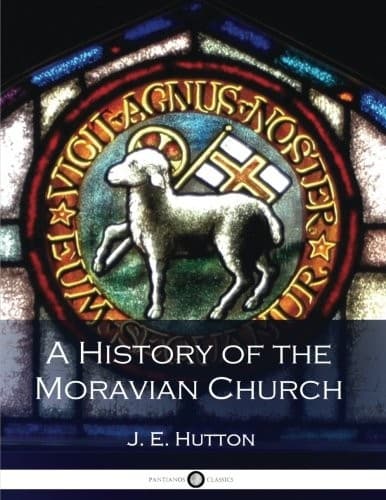
A History of the Moravian ChurchHutton, J. E. (Joseph Edmund)
Religion
A History of the Moravian Church
Hutton, J. E. (Joseph Edmund)
Moravian Church -- History
Again the Brethren differed from Luther in their doctrine of the Lord's
Supper. As this subject was then the fruitful source of much discussion
and bloodshed, the Brethren at first endeavoured to avoid the issue at
stake by siding with neither of the two great parties and falling back
on the simple words of Scripture. "Some say," they said, "it is only a
memorial feast, that Christ simply gave the bread as a memorial. Others
say that the bread is really the body of Christ, who is seated at the
right hand of God. We reject both these views; they were not taught
by Christ Himself. And if anyone asks us to say in what way Christ is
present in the sacrament, we reply that we have nothing to say on the
subject. We simply believe what He Himself said, and enjoy what He has
given."[32]
But this attitude could not last for ever. As the storms of persecution
raged against them, the Brethren grew more and more radical in their
views. They denied the doctrine of Transubstantiation; they denied also
the Lutheran doctrine of Consubstantiation; they denied that the words
in St. John's Gospel about eating the flesh and drinking the blood
of Christ had any reference to the Lord's Supper. They took the whole
passage in a purely spiritual sense. If those words, said Bishop Luke,
referred to the Sacrament, then all Catholics, except the priests, would
be lost; for Catholics only ate the flesh and did not drink the blood,
and could, therefore, not possess eternal life. They denied, in a
word, that the Holy Communion had any value apart from the faith of the
believer; they denounced the adoration of the host as idolatry; and thus
they adopted much the same position as Wycliffe in England nearly two
hundred years before. The Lord Christ, they said, had three modes
of existence. He was present bodily at the right hand of God; He was
present spiritually in the heart of every believer; He was present
sacramentally, but not personally, in the bread and wine; and,
therefore, when the believer knelt in prayer, he must kneel, not to the
bread and wine, but only to the exalted Lord in Heaven.
Public-domain text, read in full here on John Shaqi.
Reviews
Reviews
No reviews yet
Be the first to share your thoughts on this work.
Elsewhere in the archive
Join the Discussion
Join the discussion
Sign in to leave a comment or review.
Sign InorCreate an account