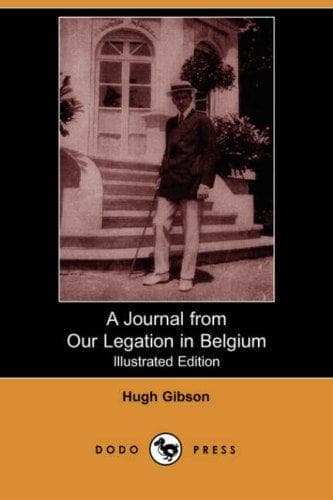
A Journal From Our Legation in BelgiumGibson, Hugh
History
A Journal From Our Legation in Belgium
Gibson, Hugh
Belgium -- History -- German occupation, 1914-1918
We found the place in a great hubbub--everybody packed and ready to
leave. They had been on the point of departure since Friday, and the
uncertainty had got on everybody's nerves--and no wonder.
Several thousand British Marines had arrived and were doing good work,
holding back the Germans, while the exhausted Belgians pulled themselves
together for the evacuation. The Belgian forces had been fighting with
little rest and no sleep until they were physically incapable of further
resistance. How human strength held out so long is the great marvel.
Winston Churchill was in the Legation when I arrived, with General
Rawlinson and Colonel Seeley.
After a call at the Foreign Office, most of which had been installed on
a boat in the river, I went to the Palace to see General Jungbluth. He
was not there, but Countess de Caraman-Chimay said that the King wanted
to see me.
I was taken straight up to him in his Council Chamber, where I found him
seated at a great table covered with maps and papers. He pushed them
aside wearily as I came in, and rose to greet me. He talked at some
length on the war and the ordeal of Belgium, but was chiefly interested
in how the people were being treated. His interest was not only for his
own friends, but he showed particular interest in learning how the
poorer people were being treated--whether the poorer quarters of the
town were keeping calm and avoiding trouble with the Germans. He was
most anxious that they should avoid doing anything that would arouse the
Germans against them. He spoke simply and touchingly of his confidence
in the loyalty and patriotism of all his people, and his certainty that
they would come through the war with an even greater love of country.
The rest of the Palace was in confusion, with servants packing and
orderlies coming and going. But the King's room was in perfect calm. The
King sat quite still in his armchair and talked quietly, without haste.
He was very serious, and it was clearly to be seen that he felt his
responsibility and the suffering of his army. But his determination was
just as evident. He realised that the evacuation was inevitable, and
having made up his mind to that, he devoted his whole energies and
thoughts to seeing that it was carried out effectively and quickly. He
has a very patent faculty of concentration and of eliminating his own
personality and feelings. I have seldom felt so sorry for anyone, partly
perhaps because all of his sympathy was for others.
When the King finally rose to dismiss me, he said:
"The Queen wants to see you. Will you come back at half-past two?"
I had planned to leave for Brussels immediately after luncheon, but, of
course, this was a command to which I gladly yielded.
Public-domain text, read in full here on John Shaqi.
Reviews
Reviews
No reviews yet
Be the first to share your thoughts on this work.
Elsewhere in the archive
Join the Discussion
Join the discussion
Sign in to leave a comment or review.
Sign InorCreate an account