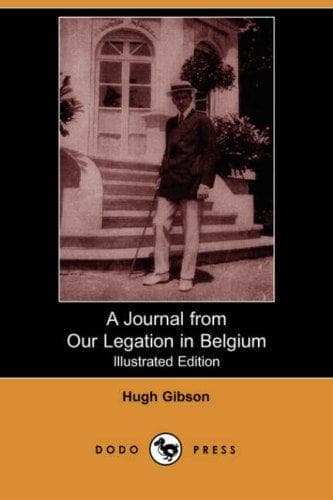
A Journal From Our Legation in BelgiumGibson, Hugh
History
A Journal From Our Legation in Belgium
Gibson, Hugh
Belgium -- History -- German occupation, 1914-1918
In the shelter of the farm-houses were fifty or sixty men, some of them
cooking their lunch, others sleeping, all quite oblivious of the roar of
bursting shrapnel and the spattering of the bullets near by. And a few
months ago probably any of these men would have been frightened into a
fit by a shell bursting in his neighbourhood. It is wonderful how soon
people become contemptuous of danger. The horses that were tethered by
the roadside seemed to take it all as a matter of course, and munched
away at their hay, as though all the world were at peace. A wobbly cart
came creaking by with an infantryman, who had had a good part of his
face shot away. He had been bandaged after a fashion and sat up blinking
at us stupidly as the cart lumbered by, bumping into holes and sliding
into ruts.
I was not keen on staying longer than was necessary to see what was
there, but W.---- was very deliberate and not to be budged for more than
half an hour. We finally got him started by calling his attention to the
spent balls, which make a tremendous singing noise, but do no harm. The
only really safe thing in the neighbourhood was what did the trick. The
Germans were making a furious attack, evidently determined to break the
line before the fresh troops could be brought up, and the cannonading
was terrific. The whole front as far as we could see in either direction
was a line of puffs of smoke from bursting shrapnel and black spouts of
earth from exploding shells. The crackle of the _mitrailleuses_ rippled
up and down the whole line. The Belgians were pounding back as hard as
they could and the noise was deafening. Finally, when we decided to
leave, the officer in command of the battery loaded all five guns at
once and fired a salvo for our benefit. The great shells tore away,
roaring like so many express trains, and screaming like beasts in
agony--a terrifying combination. My ears ache yet. It was getting hotter
every minute and the Germans were evidently getting a better idea of the
range, for the shells began falling pretty close on the other side, and
I was quieter in my mind when we went back to our cars and pulled out of
the actual line. We took a road a few hundred yards back, parallel with
the lines, and drove along slowly, watching the effect of the shell
fire, until we absolutely had to start back for lunch. On the way we
stopped at a peasant's hut, and said hello to Jack Reyntiens.
Public-domain text, read in full here on John Shaqi.
Reviews
Reviews
No reviews yet
Be the first to share your thoughts on this work.
Elsewhere in the archive
Join the Discussion
Join the discussion
Sign in to leave a comment or review.
Sign InorCreate an account