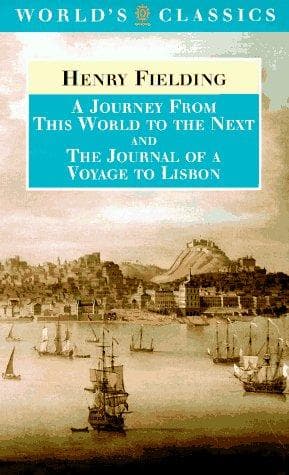
A Journey from This World to the NextFielding, Henry
General
A Journey from This World to the Next
Fielding, Henry
English fiction; Paranormal fiction; Supernatural -- Fiction
“The most general, and indeed the truest, maxim among us was, that those
who possessed the least were always the readiest to give. The chief art
of a beggar-man is, therefore, to discern the rich from the poor, which,
though it be only distinguishing substance from shadow, is by no
means attainable without a pretty good capacity and a vast degree of
attention; for these two are eternally industrious in endeavoring to
counterfeit each other. In this deceit the poor man is more heartily
in earnest to deceive you than the rich, who, amidst all the emblems
of poverty which he puts on, still permits some mark of his wealth to
strike the eye. Thus, while his apparel is not worth a groat, his finger
wears a ring of value, or his pocket a gold watch. In a word, he seems
rather to affect poverty to insult than impose on you. Now the poor man,
on the contrary, is very sincere in his desire of passing for rich; but
the eagerness of this desire hurries him to over-act his part, and he
betrays himself as one who is drunk by his overacted sobriety. Thus,
instead of being attended by one servant well mounted, he will have two;
and, not being able to purchase or maintain a second horse of value,
one of his servants at least is mounted on a hired rascallion. He is
not contented to go plain and neat in his clothes; he therefore claps on
some tawdry ornament, and what he adds to the fineness of his vestment
he detracts from the fineness of his linen. Without descending into more
minute particulars, I believe I may assert it as an axiom of indubitable
truth, that whoever shows you he is either in himself or his equipage
as gaudy as he can, convinces you he is more so than he can afford. Now,
whenever a man’s expense exceeds his income, he is indifferent in the
degree; we had therefore nothing more to do with such than to flatter
them with their wealth and splendor, and were always certain of success.
“There is, indeed, one kind of rich man who is commonly more liberal,
namely, where riches surprise him, as it were, in the midst of poverty
and distress, the consequence of which is, I own, sometimes excessive
avarice, but oftener extreme prodigality. I remember one of these who,
having received a pretty large sum of money, gave me, when I begged
an obolus, a whole talent; on which his friend having reproved him, he
answered, with an oath, ‘Why not? Have I not fifty left?’
Public-domain text, read in full here on John Shaqi.
Reviews
Reviews
No reviews yet
Be the first to share your thoughts on this work.
Elsewhere in the archive
Join the Discussion
Join the discussion
Sign in to leave a comment or review.
Sign InorCreate an account