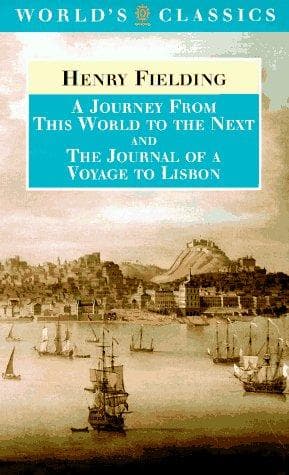
A Journey from This World to the NextFielding, Henry
General
A Journey from This World to the Next
Fielding, Henry
English fiction; Paranormal fiction; Supernatural -- Fiction
“Edward, the other son of Emma, escaped again to Normandy; whence, after
the death of Harold and Hardicanute, he made no scruple of applying to
my protection and favor, though he had before prosecuted me with all the
vengeance he was able, for the murder of his brother; but in all great
affairs private relation must yield to public interest. Having therefore
concluded very advantageous terms for myself with him, I made no scruple
of patronizing his cause, and soon placed him on the throne. Nor did I
conceive the least apprehension from his resentment, as I knew my power
was too great for him to encounter.
“Among other stipulated conditions, one was to marry my daughter Editha.
This Edward consented to with great reluctance, and I had afterwards
no reason to be pleased with it; for it raised her, who had been my
favorite child, to such an opinion of greatness, that, instead of paying
me the usual respect, she frequently threw in my teeth (as often at
least as I gave her any admonition), that she was now a queen, and
that the character and title of father merged in that of subject. This
behavior, however, did not cure me of my affection towards her, nor
lessen the uneasiness which I afterwards bore on Edward’s dismissing her
from his bed.
“One thing which principally induced me to labor the promotion of Edward
was the simplicity or weakness of that prince, under whom I promised
myself absolute dominion under another name. Nor did this opinion
deceive me; for, during his whole reign, my administration was in the
highest degree despotic: I had everything of royalty but the outward
ensigns; no man ever applying for a place, or any kind of preferment,
but to me only. A circumstance which, as it greatly enriched my coffers,
so it no less pampered my ambition, and satisfied my vanity with a
numerous attendance; and I had the pleasure of seeing those who only
bowed to the king prostrating themselves before me.
“Edward the Confessor, or St. Edward, as some have called him, in
derision I suppose, being a very silly fellow, had all the faults
incident, and almost inseparable, to fools. He married my daughter
Editha from his fear of disobliging me; and afterwards, out of hatred to
me, refused even to consummate his marriage, though she was one of the
most beautiful women of her age. He was likewise guilty of the basest
ingratitude to his mother (a vice to which fools are chiefly, if not
only, liable); and, in return for her endeavors to procure him a throne
in his youth, confined her in a loathsome prison in her old age.
This, it is true, he did by my advice; but as to her walking over nine
plowshares red-hot, and giving nine manors, when she had not one in her
possession, there is not a syllable of veracity in it.
Public-domain text, read in full here on John Shaqi.
Reviews
Reviews
No reviews yet
Be the first to share your thoughts on this work.
Elsewhere in the archive
Join the Discussion
Join the discussion
Sign in to leave a comment or review.
Sign InorCreate an account