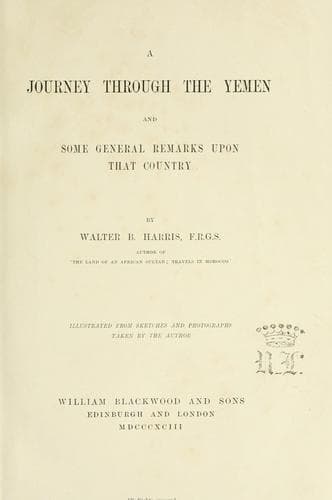
A journey through the Yemen and some general remarks upon that countryHarris, Walter
History
A journey through the Yemen and some general remarks upon that country
Harris, Walter
Yemen (Republic) -- Description and travel
The path leads one along the east side of the valley, at a great height
above the river, often, like that we had traversed the night before, only
a footway cut in the edge of the precipices. Here for the first time
we came across the coffee-plant, growing amidst tumbling waterfalls on
terraces built up against the steep mountain-side. Everywhere was water,
here in artificial channels, there in tiny streamlets. Wild flowers
abounded, and in places the walls of rock were green and white with
jasmine. A thousand feet below us were the villages, on to the roofs of
the houses of which we looked from above. It seemed but a step from us to
them. At one spot my men pointed out where a short time before a camel
and its load had fallen from an overhanging rock. It never touched the
precipice, they said, until it fell upon a ledge they pointed out to me
hundreds of feet below, and thence it bounded into the valley.
Rich in the extreme is this part of the country, owing to its everlasting
supply of water, and many are the tales the Arabs of the plains tell of
it. Beled el-Hawad they call it, of which Howra is the chief village,—a
place like a feudal castle built on a pile of rocks.
After a time the road turns to the right, and, following the course of
a small stream, ascends a valley. To the left of this valley, on the
very summit of a high mountain, is the village of Ofar, to reach which
necessitates a climb of a thousand feet or more from the road. At several
places one passes drinking-fountains, erected, like the great tanks we
were afterwards to meet with in the plateau, for the refreshment of man
and beast. They are simple affairs, but excellently built. In form they
are usually square, and domed, some six feet each way perhaps. A trough
on the outside supplies the water for the animals, while a hole in the
wall, large enough for one to insert one’s head through, is for human
beings. Within the water rises to the level of this hole, being carried
off by an overflow pipe into the trough below, so that the clear liquid
just reaches the level of one’s lips, while the roof above keeps it fresh
and cool. These fountains, common all over the Yemen, have been usually
erected by private philanthropists for the benefit of their fellow-men.
Unlike the custom in England, no flowery inscription tells the world the
name or the generosity of the builder—they are the memorials of anonymous
benefactors. Here, too, we came into contact for the first time with the
mountain camel—a very different beast from that of the Teháma and desert,
being a rough-haired, heavily-boned creature, usually black in colour
and the picture of ugliness. Those of Lahej and the surrounding country,
renowned throughout Arabia, are light in colour and remarkably finely
built, and often exceedingly pretty. To those who think that the camel is
essentially a creature of the desert, and incapable of traversing with
ease stony or rocky country, the fact that we were passing caravans of
Public-domain text, read in full here on John Shaqi.
Reviews
Reviews
No reviews yet
Be the first to share your thoughts on this work.
Elsewhere in the archive
Join the Discussion
Join the discussion
Sign in to leave a comment or review.
Sign InorCreate an account