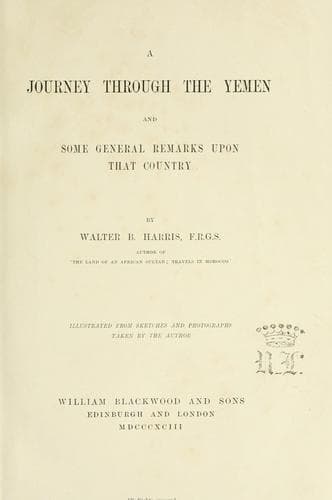
A journey through the Yemen and some general remarks upon that countryHarris, Walter
History
A journey through the Yemen and some general remarks upon that country
Harris, Walter
Yemen (Republic) -- Description and travel
Munkat is a walled village containing a considerable number of houses,
one of which, a kind of fort, is curiously perched on an enormous
boulder, and a pretty white mosque, surrounded by tanks of good water.
Built into the wall of the mosque are stones inscribed in Himyaric
characters, and some also in Kufic. Copies of the former were, I believe,
taken some years ago by Dr Glaser. In another part of the village is
a white marble column, some eight or ten feet in height, of Himyaric
origin, which is said by the villagers to have appeared suddenly at
this spot. The ignorance of the natives in this part of the country
is astonishing; for out of many stones they showed me, some were in
Arabic and some in the Himyaric character, but the inhabitants were
uncertain as to which was which. They seemed, however, to reverence
these remains to some extent, as they had carefully built them into the
walls. At one spot, over a doorway and in a prominent position, they
had carefully placed a marble stone containing the first chapter of the
Koran—“Bismillah Alrahman Alrahim,” &c.—upside down. When I told them of
their mistake, it was quite sad to hear their excuses. “We are only poor
people,” they said, “and we are terribly taxed. We have to till the soil
to feed ourselves and the Osmanli Pashas, and there is no time to learn
to read or write.” In many parts of the country to such an extent do they
have “to feed the Osmanli Pashas,” that they scarcely get ought to eat
themselves. It is the old tale of cruelty and oppression, of extortion
and corruption.
The regard shown by the poor villagers of Munkat for these inscribed
stones is not by any means uncommon, a great reverence for writing being
innate in all Arab peoples. I once had an Arab servant, himself perfectly
illiterate, who treasured a torn manuscript copy of the ‘Arabian Nights.’
Its contents he did not know, nor had he ever taken the trouble to find
out: that it was a _book_ was sufficient for him, and he carried it about
as a sort of talisman. In spite of its good luck, it did not keep him out
of prison, when one day he helped himself to things that weren’t his.
One of the most beautiful sights to be seen upon the plateau of the Yemen
are the lizards—little creatures of gorgeous metallic blue, now pale
turquoise, now transparent sapphire, as the sunlight dances on their
backs. In no other part of the world have I come across such gorgeously
coloured reptiles, although I have seen the same lizard, but less
brilliant in hue, in the mountains of the Zarahoun, to the north of the
road between Fez and Mequinez, in Morocco.
An hour or two more of winding path and we were in sight of Yerim, one of
the principal towns of the Yemen, which but a short time before had been
taken by the Arabs in the rebellion, and retaken by the very Ismail Pasha
whose camp we had seen at Kátaba.
CHAPTER VI.
YERIM TO DHAMAR.
Public-domain text, read in full here on John Shaqi.
Reviews
Reviews
No reviews yet
Be the first to share your thoughts on this work.
Elsewhere in the archive
Join the Discussion
Join the discussion
Sign in to leave a comment or review.
Sign InorCreate an account