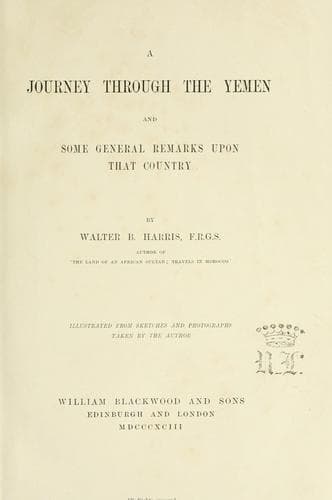
A journey through the Yemen and some general remarks upon that countryHarris, Walter
History
A journey through the Yemen and some general remarks upon that country
Harris, Walter
Yemen (Republic) -- Description and travel
As soon as it was cool enough, under the guidance of Saïd, who knew
the place well, I sauntered out and strolled through the bazaars; but
although I wore on my head a Turkish fez, all sorts of rumours had been
spread about concerning me, and I was the whole time the centre of a
large crowd, who, though they pressed me rather hard, were polite but
dirty, so that I found it advisable after a short time to beat a retreat.
Yerim apparently has no great pretensions to antiquity, although
there formerly stood on the same spot, or somewhere in the immediate
neighbourhood, a city of the name of Dhu-Ruayn. The ancient capital of
this district is Zafar, the ruins of which, lying some miles to the
south-east, are still visible on the summit of a circular hill.
There is but little to see in Yerim. The town is essentially a poor
one, and although built partly on the slope of a mountain where stone is
procurable, the houses are almost entirely composed of sun-dried bricks.
Dirt and squalor abound on every side, and the streets of narrow bazaars
show no signs of any great commerce or trade. What little importance the
place can lay claim to is owing to the fact that it lies on the main
road from Sanaa to Aden, and is a garrisoned city. Like Dhamar, it fell
into the hands of the Arabs during the rebellion at the end of 1891, but
was retaken by Ismail Pasha, whom we had seen a month or two after its
recapture, encamped at Kátaba. The Arabs, however, seem to have gone to
no excesses; and beyond taking prisoner the Kaimakam, who was still at
this time in the hands of the Imam at Sadah, and his officers, behaved
with great leniency toward the Turks, many of whom threw in their lot
with the Arab cause.
During the evening I received many callers, who came probably from
curiosity rather than from any other reason. Amongst them were several of
the “Ashraf,” of the family of Ahmed ed-Din, the leader of the rebellion,
who had seen all through that their cousins’ cause was a hopeless one,
and had remained neutral during the war. I found them exceedingly
pleasant, and they conversed for a long time about their country. One was
especially a fine man, young and exceedingly handsome. As is the custom
amongst the nobility, these guests all had closely-shaven heads. One
or two of them were richly dressed in silk robes, and wore daggers of
exquisite silver and gold work. It was late before I got rid of the last
of them, and was able to seek a few hours’ rest before starting again.
Public-domain text, read in full here on John Shaqi.
Reviews
Reviews
No reviews yet
Be the first to share your thoughts on this work.
Elsewhere in the archive
Join the Discussion
Join the discussion
Sign in to leave a comment or review.
Sign InorCreate an account