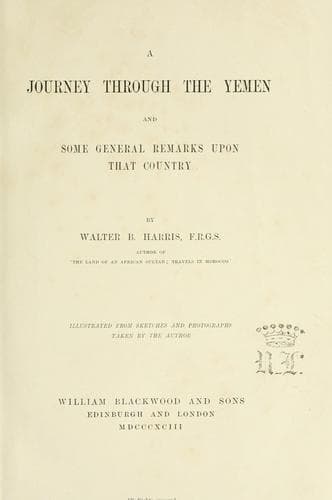
A journey through the Yemen and some general remarks upon that countryHarris, Walter
History
A journey through the Yemen and some general remarks upon that country
Harris, Walter
Yemen (Republic) -- Description and travel
Ibn Khaldun, in his geography of the Yemen, makes no mention of Dhamar,
but this can scarcely be looked upon as meaning that the town did not
exist in his day—in fact, it is more probable that his failing to notice
the place was due to an omission, as the neighbouring fortress of Hirran
is also left without mention, though from the remains existing there it
is very probable that it was a site and fortress of no little importance
in far earlier times than that of the native geographer; and El-Janadi,
in his account of “The Karmathians,” speaks of the capture of Hirran
by Ibn Fadl about the year 293 A.H., and as the fall of the fortress
was only one item of the leaders successful march to Sanaa, it is very
probable that the event was considered one of no little importance.
Several of the other early Arab historians make direct mention of Dhamar
itself.
[Illustration: ROUTE MAP—DHAMAR TO SANAA
BY W. B. HARRIS
W. & A. K. Johnston. Edinburgh & London.]
A few hours after my arrival in the city I sauntered out with Saïd to the
bazaars, to purchase a few little luxuries in the way of food and fruit,
for so far we had lived during our journey upon the bare necessities of
life. Although at times a considerable crowd thronged us, we found the
people extremely polite, and what little inconvenience we were put to was
owing entirely to the curiosity of the inhabitants. The bazaars boast
but little beyond their natural picturesqueness, which in many places is
most noticeable. The shops are the usual little one-storeyed box-like
dens of the Eastern world, and the trades are divided up into separate
streets and quarters. Here, as elsewhere, the Jews have an entirely
separate town, situated to the east of the city, from which it is divided
by a large open space. Near this great square is the principal mosque
of the town, a walled enclosure, with three large gates facing the city,
and a handsome, though damaged, minaret. In one respect, however, it
is in better order than that of another of the mosques, for it still
maintains its upright position, whereas the other is sadly out of the
perpendicular, owing to its having been struck by a cannon-ball. A third
mosque of considerable size is within the bazaars, but none of them
possess much claim to architectural beauty, being built in the simple and
undecorative Arab style, native cement and mud-bricks being the principal
materials used in their construction. Prettier, certainly, are one or two
of the Shereefian tombs, with their white domes and arcades of arches.
One of these, lying on the extreme south of the city, near where we had
entered the town, is realty charming, with a small garden in front of it
and a huge shady tree for the pilgrims to the sanctuary to rest under.
Near here, but standing separate from the town, we saw the ruins of the
Turkish barracks, which had been destroyed by the Arabs on their capture
of Dhamar from the Turks a few months before.
Public-domain text, read in full here on John Shaqi.
Reviews
Reviews
No reviews yet
Be the first to share your thoughts on this work.
Elsewhere in the archive
Join the Discussion
Join the discussion
Sign in to leave a comment or review.
Sign InorCreate an account