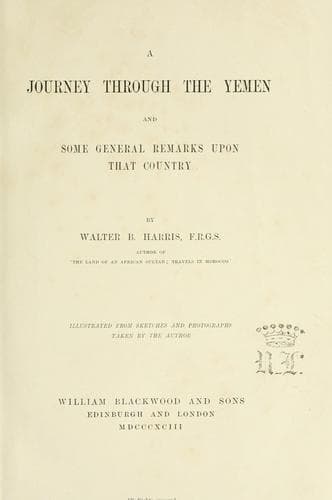
A journey through the Yemen and some general remarks upon that countryHarris, Walter
History
A journey through the Yemen and some general remarks upon that country
Harris, Walter
Yemen (Republic) -- Description and travel
From the bazaars to the town walls is but a step. Passing out of the
fortified gates, of which there are several, one issued on to the large
open space, the _sôk_ or market, which we had crossed when we entered
the town. Here garden produce was offered for sale, generally exposed on
the ground, though a number of little mat-and-reed huts contained small
shops. The larger of these flimsy structures serve as _cafés_, and one
or two as Parsee theatres. The largest of the _cafés_ was a constant
resort of mine, and of an evening I would sit, accompanied by Saïd,
who, in spite of his fever, had polished up his dress—what there was of
it—and his raven locks. So beautiful had he become that little groups
of the female sex would come and joke with him; and though he treated
them with a certain amount of haughty indifference, he was by no means
unappreciative of their attentions, and had a knack of being out after
dark. There one would see the Turkish officers in gold-lace, with their
glass hookahs in front of them, lounging away the afternoon hours. There,
too, were the merchants, gorgeous in silk raiment and turbans, talking
business over coffee and tobacco.
The remaining streets and places of Hodaidah offer but little
attractiveness. The streets are narrow and the houses high, and except
now and again for a richly carved doorway, there is but little of
interest to be seen.
The greatest disadvantage to Hodaidah, after its feverish climate, is
the exceedingly poor water-supply; for although there are some brackish
wells in the neighbourhood, all pure water has to be brought from a
distance of some miles. It is carried in skins and barrels on the backs
of camels and donkeys.
Near these wells, under the guidance of Dr Ahmed, I spent a pleasant
afternoon in a beautiful garden belonging to a certain wealthy Arab,
whose fortune was made, it is said, by purchasing the right of collecting
taxes from the Ottoman Government. This, in the hands of an unscrupulous
and hard man, means a very considerable income, and the garden in
question was a proof that the old Arab evidently throve. The road from
the town passes along sandy lanes and amongst palm-groves until the open
desert is reached. Continuing over this for a mile or so, one reaches the
wells, while green trees peeping over the high garden walls break the
monotony of sand and scrub.
Public-domain text, read in full here on John Shaqi.
Reviews
Reviews
No reviews yet
Be the first to share your thoughts on this work.
Elsewhere in the archive
Join the Discussion
Join the discussion
Sign in to leave a comment or review.
Sign InorCreate an account