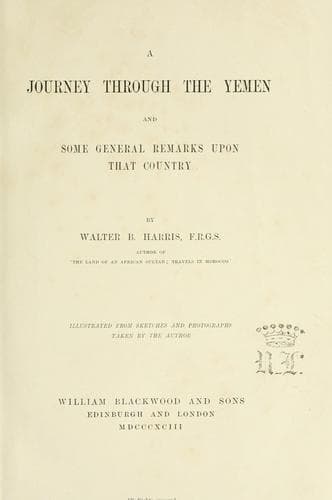
A journey through the Yemen and some general remarks upon that countryHarris, Walter
History
A journey through the Yemen and some general remarks upon that country
Harris, Walter
Yemen (Republic) -- Description and travel
Almost as suddenly as the gale had come on it died down again, and
during the afternoon we were able once more to push on upon our journey.
Reaching El-Amat, a fort of the Sultan of the Houshabi tribe, I delivered
the letter of recommendation I bore from the Political Resident at
Aden, and, refusing the Sheikh’s kind invitation to alight, pushed on.
This fort, like that of the Sultan of Lahej which we had passed shortly
before, is a large, square, mud building, two storeys in height. Useful
as it may be in times of war as a defence against Arabs armed only with
matchlock-guns and spears, it would not stand a couple of shot from any
field-gun, unless the structure is so soft that the ball would go right
through it, as is not improbable. Near this spot we came across a herd of
gazelle, but they were gone and out of sight long before we came within
range.
The tribe in whose country we now were is the Houshabi. They have always
been on the best of terms with the British, and on the murder of Captain
Milne in 1851, elsewhere referred to, they refused to harbour the
assassin, a fanatical Shereef. By their position they have an advantage
over the Abdali tribe, of which Lahej is the capital, as the river of
the latter is supplied with water from the ravines and mountains of the
interior of the Houshabi territory, and they have on several occasions
in times of war been known to divert its course. However, happily, the
relations of the two tribes are for the most part friendly, so that it is
not often that they have recourse to such extreme measures.
On again over the desert, which, as we approached the rocky hills, showed
more signs of vegetation and life. Here and there were Arabs tending
flocks and herds and cattle, though what there was for them to graze upon
beyond the thorny bushes it was difficult to say. At length we left the
sandy plain and entered a deep narrow gorge at the foot of Jibel Menif,
a high barren mountain. Here the scene entirely changed. Instead of over
the open expanse of desert, our way now led us between walls of rock,
the path often a mere track in the river-bed, in which at places water
was running, and at others had sunk for a time below the surface.
Afternoon was well on, and the change from the sunlight outside to
the cool depths of the gorge was a pleasant one, but the scene looked
sepulchral and gloomy. The rocks with which the river-bed was strewn and
the cliffs on either hand were of a curious black colour; nor did the
scanty vegetation, consisting principally of what the Arabs call _athl_,
a thorny mimosa, do much by their verdure to enliven the scene, for in
spite of their proximity to a stream which made some pretence at running
water, they looked parched and withered and dry.
Public-domain text, read in full here on John Shaqi.
Reviews
Reviews
No reviews yet
Be the first to share your thoughts on this work.
Elsewhere in the archive
Join the Discussion
Join the discussion
Sign in to leave a comment or review.
Sign InorCreate an account