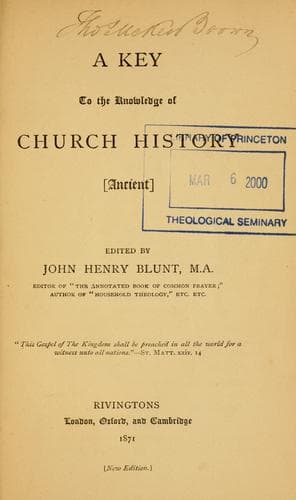
A Key to the Knowledge of Church History (Ancient)Blunt, John Henry
History
A Key to the Knowledge of Church History (Ancient)
Blunt, John Henry
Church history -- Middle Ages, 600-1500; Church history -- Primitive and early church, ca. 30-600
So far we have contemplated the Church of Christ as one in external
communion, no less than by the inner bonds of charity and of
sacramental life; but we now come to a period in which this external
unity began to be to a certain extent dissolved, and that in great
measure by the same outward influences which had at first secured its
cohesion. [Sidenote: with the breaking up of the Roman Empire.]
Heresies and schisms, especially the great heresy of Arius, had indeed
troubled the Church and threatened to break the visible union existing
between its branches in different countries; but it was not until after
the dissolution of the Roman empire that the breach really came.
Section I. _Jealousy between Rome and Constantinople._
[Sidenote: Reasons for Roman ascendancy.]
During the flourishing days of the empire the city of Rome had
naturally been looked up to with great reverence by all the other
Churches of the world. Its political importance as the centre of
government, the vast number {95} of its martyrs, its comparative
freedom from heresy, and its connexion with the lives and deaths of St.
Peter and St. Paul, all tended to give it a moral ascendancy which was
gradually claimed as a right. This, however, did not take place
without protests on the part of other Bishops, nor even without very
definite disclaimers of any wish for or right to supreme authority on
the part of the Bishops of Rome themselves.
[Sidenote: Ambition of an Eastern Patriarch.]
Constantinople, as being the new Rome and capital of the Eastern
empire, was especially jealous of the claims of the mother city, and
one of her Patriarchs, John the Faster, in the sixth century, first set
the evil example of assuming the title of "Universal Bishop," a title
which the Roman Pontiffs have since taken and retained. In proportion
as the political division between East and West became more complete,
so also did the tendency towards separation in ecclesiastical matters
increase. [Sidenote: Beginnings of disunion.] Western dioceses, now
peopled by the barbarian nations who had overrun Europe, still looked
up to Rome as their centre and head; whilst the Eastern Bishops, under
the sway of the decaying empire, clung to Constantinople. [Sidenote:
Its crisis.] The controversy respecting the use of Images, and that
about the Procession of the Holy Ghost from the Son as well as from the
Father, were, however, the means of actually bringing about the
cessation of all outward communion between East and West.
Section 2. _The Iconoclast (or Image-breaking) Controversy._
[Sidenote: Dislike of images]
Public-domain text, read in full here on John Shaqi.
A Key to the Knowledge of Church History (Ancient) — John Shaqi
Reviews
Reviews
No reviews yet
Be the first to share your thoughts on this work.
Join the Discussion
Join the discussion
Sign in to leave a comment or review.
Sign InorCreate an account