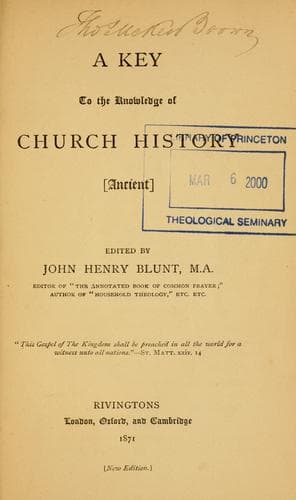
A Key to the Knowledge of Church History (Ancient)Blunt, John Henry
History
A Key to the Knowledge of Church History (Ancient)
Blunt, John Henry
Church history -- Middle Ages, 600-1500; Church history -- Primitive and early church, ca. 30-600
There had been from very early times an extensive though not universal
feeling in the Church, against the use of painting or sculpture in {96}
Divine Worship. This feeling was occasioned partly by dread of the
idolatry still prevalent amongst the heathen, and partly, especially in
the East, where it was strongest, by the remains of Judaism still
lingering in the Church of Christ. [Sidenote: lost in the West, but
retained in the East.] As heathenism died out, it was gradually felt in
the West that the strong reasons formerly existing against the
adornment of Churches with pictures and images had passed away; but the
Eastern Church, with that dread of change which distinguishes it to
this day, clung as before to the old sentiment.
[Sidenote: Image-breaking legislation]
In the eighth century, Leo III., "the Isaurian," then reigning at
Constantinople, passed a decree for the removal of all images and
paintings from Churches, and his violent conduct in the matter
occasioned such discontent in the West, that Italy withdrew altogether
from the nominal allegiance she had hitherto paid to the emperors,
about A.D. 730. [sidenote: dissolved the link between Eastern and
Western Empires.] Other emperors were as fanatical in their
Iconoclastic (or image-breaking) prejudices as Leo, and their
extravagance excited a reaction in the other extreme in the Western
empire. [Sidenote: Reactionary decrees in the West.] In A.D. 786, a
Council, which was held at Nicaea, not only protested against the
violent fanaticism of the East, but sanctioned the veneration of images
and pictures to an extent which we find it hard to justify, and which
was, in fact, deemed unjustifiable by many in the West, who yet wished
for their retention as decorations and aids to devotional feeling.
Charlemagne, under the influence of our English Alcuin, opposed the
decision of the Council, and held provincial synods (especially one at
Frankfort, A.D. 794) {97} to condemn what was, at any rate, very like
image-worship.
[Sidenote: Charitable supposition regarding them.]
Probably dread of Judaism and Mahometanism, with their hatred of our
Blessed Lord and of His Image, as well as of all sculpture, had some
influence on the decisions of the council of A.D. 786, and we may
reasonably hope that it was not really intended to encourage any
worship or veneration contrary to the express law of God. At any rate,
the Iconoclast controversy aided very strongly to put an end to all
political union, and with it to all public ecclesiastical intercourse,
between East and West; though the bonds of external communion were not
yet broken, and they were still one both in faith and practice.
Section 3. _The Controversy respecting the Double Procession of the
Holy Ghost._
[Sidenote: Western addition to the Nicene creed.]
Public-domain text, read in full here on John Shaqi.
Reviews
Reviews
No reviews yet
Be the first to share your thoughts on this work.
Join the Discussion
Join the discussion
Sign in to leave a comment or review.
Sign InorCreate an account