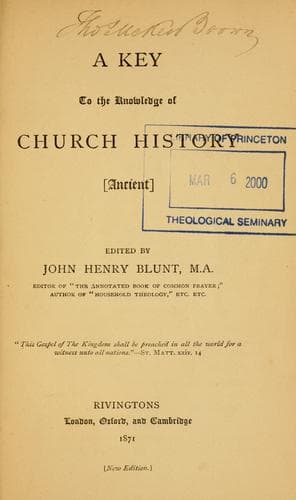
A Key to the Knowledge of Church History (Ancient)Blunt, John Henry
History
A Key to the Knowledge of Church History (Ancient)
Blunt, John Henry
Church history -- Middle Ages, 600-1500; Church history -- Primitive and early church, ca. 30-600
We have seen[1] that the summary of Christian belief, known to us as
the Nicene Creed, was completed at the Council of Constantinople, A.D.
381; but with this exception, that the article defining the faith of
the Church concerning the Third Person of the Ever-Blessed Trinity,
asserted only that "the Holy Ghost . . . . proceedeth from the Father,"
without the addition of the words "_and the Son_;" and it was the
controversy as to the admission or non-admission of these words into
the Creed which caused the formal division between Eastern and Western
Christendom. The question is said to have first arisen in the fifth
{98} century; and gradually the words in dispute came to be sung in the
West during Divine Service. [Sidenote: Decrees against it.] In the
ninth century an appeal was made on the subject to Pope Leo III., who
decided in a provincial Council that no such addition could lawfully be
made to the Creed, and ordered it to be engraved on silver plates
exactly as the Council of Constantinople had left it. Towards the end
of the same century another Council was held at Constantinople, which
also decreed the disuse of the addition, and then the matter dropped
for about a hundred and fifty years. [Sidenote: Dispute stirred up
again for political purposes.] Its revival seems to have been chiefly
owing to political jealousies and to the struggle for supremacy which
was continually going on between Rome and Constantinople. We may be
allowed to believe that the dispute was, in reality, a question of mere
words, and that the two branches of the One Church did, and still do,
hold the "One Faith," although differing in their mode of expressing
it. [Sidenote: Actual schism in consequence.] Still the
ultra-conservatism which has always distinguished the Eastern Church,
and the unyielding temper which has been no less conspicuous in the
Church of Rome, did in time bring about a formal schism; and in A.D.
1053, the Pope Leo IX. issued a sentence of excommunication against the
Patriarch of Constantinople and all who adhered to him. In the
following year the Patriarch Michael Cerularius summoned a synod at
Constantinople, and retorted the excommunication upon the Latins. Two
attempts at reconciliation were afterwards made, one in A.D. 1274,
following the close of the last Crusade, and another which, after
lengthened negotiations, came to an equally unsuccessful termination at
the Council of Florence, A.D. 1430.
{99}
[Sidenote: Outward union never since restored.]
Since that time the two great Branches of the One Vine, whilst still
drawing Life and Nourishment from the same Divine Root of Jesse by
means of the same Holy Sacraments, have yet abstained from all acts of
outward communion, and have failed to recognize in each other those
essential marks of Catholicity which God's Mercy and Providence has
preserved to them even in the midst of all their respective defects of
Charity, or their errors in theory and practice.
[1] Chap. VI., sec. 3.
Public-domain text, read in full here on John Shaqi.
Reviews
Reviews
No reviews yet
Be the first to share your thoughts on this work.
Elsewhere in the archive
Join the Discussion
Join the discussion
Sign in to leave a comment or review.
Sign InorCreate an account