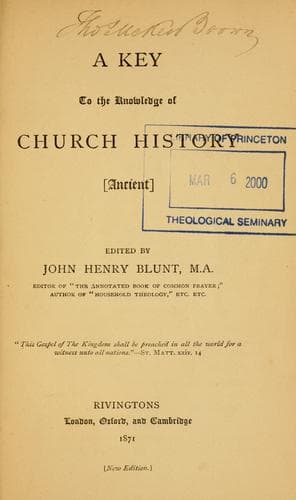
A Key to the Knowledge of Church History (Ancient)Blunt, John Henry
History
A Key to the Knowledge of Church History (Ancient)
Blunt, John Henry
Church history -- Middle Ages, 600-1500; Church history -- Primitive and early church, ca. 30-600
The Reformation was in fact a casting off of an unjustifiable
usurpation in temporal as well as in spiritual things, and a violent
reaction against that course of events which, from the eighth century
downwards, had been tending to reduce the different sovereigns of
Western Christendom to the rank of vassals of the Roman See.
Section 2. _Some account of the Popes of the Middle Ages._
A clearer view of the rise and results of papal supremacy may perhaps
be gained by entering into a somewhat more detailed account of such
Popes as from various causes occupy conspicuous places in the history
of the Roman Church. [Sidenote: St. Leo the Great, and the first
"papal aggression."] In order to do this effectually, it will be
necessary to go back a little farther than the date at the head of the
chapter, to the time of St. Leo the Great (A.D. 440-A.D. 461), whose
claim to interfere between St. Hilary, Bishop of Arles, and
Chelidonius, Bishop of Besancon, may be looked upon as the first "papal
aggression" of which history gives us an example. Chelidonius had been
deposed by a General Council of the Church of France under the
presidency of Hilary, and so deeply did the French Bishops resent the
unjust attempts of Leo to set aside their decision, that the Bishop of
Rome found an appeal to the secular power necessary for the purpose of
enforcing his claim to exercise jurisdiction over a foreign Church.
But even the authority of Valentinian III., Emperor of the West, did
not succeed in obliging Hilary to cede the liberties of the Church of
France, and it is a significant fact that the Bishop of {103} Arles is
reverenced as a saint by the whole Western Church, although his sense
of what was due to his position as a member of the French episcopate
would not suffer him to yield his just rights, in order to obtain a
reconciliation with one so personally worthy of esteem and honour as
St. Leo.
[Sidenote: Papal claims strengthened and extended by St. Gregory]
Public-domain text, read in full here on John Shaqi.
Reviews
Reviews
No reviews yet
Be the first to share your thoughts on this work.
Elsewhere in the archive
Join the Discussion
Join the discussion
Sign in to leave a comment or review.
Sign InorCreate an account