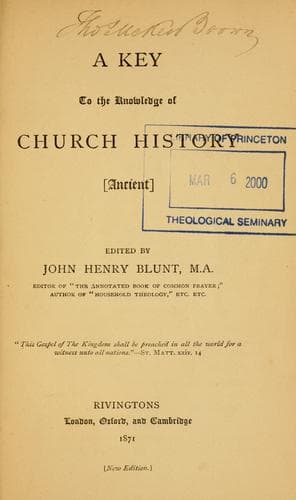
A Key to the Knowledge of Church History (Ancient)Blunt, John Henry
History
A Key to the Knowledge of Church History (Ancient)
Blunt, John Henry
Church history -- Middle Ages, 600-1500; Church history -- Primitive and early church, ca. 30-600
The good and wise St. Gregory the Great (A.D. 590-A.D. 604), though he
strenuously disclaimed for himself, and denied to others, the right of
assuming the title of "Universal Bishop," appears to have had very
strong ideas respecting the authority which he conceived to belong to
the successors of St. Peter, whilst his talents and holiness gave him
an extensive influence over his contemporaries. [Sidenote: and Hadrian
I.] Succeeding Popes laid claim to more extended powers, especially
Hadrian I. (A.D. 772-A.D. 793), who first advanced the doctrine that
the whole Christian Church was subject to the see of Rome. [Sidenote:
Rise of the temporal power of the Popes under Leo III.] His successor,
Leo III. (A.D. 795-A.D. 816), having crowned Charlemagne Emperor of the
West, A.D. 800, received from that monarch the sovereignty of Rome, and
thus became a temporal prince as well as a Bishop, and about the same
time there began to appear certain forged canons (or Church laws),
professing to be ancient decrees collected by St. Isidore of Seville,
in the seventh century, and having for their object to give primitive
sanction to Roman Supremacy. [Sidenote: "Pseudo-Isidore" Decretals]
These "Pseudo-Isidore" Decretals, as they were afterwards called, were
frequently appealed to, apparently in good faith, by subsequent Popes;
and their genuineness was generally believed in, almost without
question, until the time of the Reformation in {104} the sixteenth
century. By about the middle of the ninth century these decretals were
made use of to settle ecclesiastical questions, and Nicholas I. (A.D.
858-A.D. 867) laid great stress upon them when the liberties of the
French Church were again defended by Hincmar, Archbishop of Rheims, in
a very similar case to that in which St. Hilary had offered opposition
to St. Leo. [Sidenote: Hincmar's opposition to papal claims.]
Hincmar's zeal in opposing the usurpations of the Roman see had some
little success during the episcopate of Hadrian II. (A.D. 867-A.D.
872), but its effects passed away when John VIII. (A.D. 872-A.D. 882)
espoused the cause of Charles the Bald, and thus enlisted the interests
of the crown on his side.
Public-domain text, read in full here on John Shaqi.
Reviews
Reviews
No reviews yet
Be the first to share your thoughts on this work.
Elsewhere in the archive
Join the Discussion
Join the discussion
Sign in to leave a comment or review.
Sign InorCreate an account