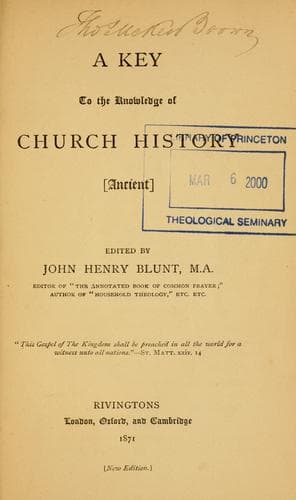
A Key to the Knowledge of Church History (Ancient)Blunt, John Henry
History
A Key to the Knowledge of Church History (Ancient)
Blunt, John Henry
Church history -- Middle Ages, 600-1500; Church history -- Primitive and early church, ca. 30-600
The troubles and disorders consequent on the breaking up of the great
empire of Charlemagne, had had a very injurious effect on morals and
religion; and unworthy persons, to whom the temporal possessions of the
Popes had by this time become an object of ambition, took advantage of
the depressed state of the Church to seize upon the bishopric of Rome
either for themselves or for others in whom they had an interest.
[Sidenote: Unspirituality caused by temporal power.] Hence the history
of the papacy during the next century and a half is full of dreary
records of corruption and wickedness. The elevation of John XII. to
the papal throne at the age of eighteen (A.D. 955), and his evil life,
called forth the interference of the Emperor Otho the Great, who
deposed him and elected Leo VIII. (A.D. 963-A.D. 965) in his stead.
[Sidenote: Interference of Emperors of the West.] From this time the
emperors frequently interfered to check the continual disputes between
Popes and anti-Popes, which often ended in the murder of one of the
rivals. Silvester II. (Gerbert) (A.D. 999-A.D. 1003), {105} who was
made Pope through the influence of Otho III., was prevented by death
from carrying out the reforms he meditated, and at length, in A.D.
1046, the Emperor Henry III. was called upon to decide between three
claimants to the papal throne. He settled the question by appointing a
German, Clement II. (A.D. 1046-A.D. 1047), after the synod of Sutri had
put aside the claims of the original disputants. Henry thus took the
election of the Popes entirely out of the hands of the Clergy of Rome,
with whom it had hitherto nominally rested, and appropriated it to
himself. [Sidenote: This interference unjustifiable.] This was an
undoubted usurpation on the part of the secular power, though Henry
seems to have been in earnest in his endeavours to check the simony
which had been so disgracefully prevalent in the papal elections, and
to appoint Bishops who might be worthy of their position. [Sidenote:
Hildebrand's influence.] [Sidenote: Overthrow of secular interference.]
Leo IX. (A.D. 1048-A.D. 1054) and his successor, Victor II. (A.D.
1055-A.D. 1057), aided and influenced by the famous Hildebrand
(afterwards Gregory VII.), succeeded in effecting considerable reforms
in religion and morals, and were very zealous in discouraging
simoniacal appointments to offices in the Church, but a gradual and
increasing resistance was growing up against the imperial
encroachments, and after the death of Henry, Pope Nicholas II. (A.D.
1059-A.D. 1061) was enabled to obtain a decree that the election of the
Popes should, for the future, rest with the Roman Cardinals, subject to
the consent of the Roman Clergy and people, and with some vague
reference to the emperor's wishes.
[Sidenote: Hildebrand Pope.]
Public-domain text, read in full here on John Shaqi.
Reviews
Reviews
No reviews yet
Be the first to share your thoughts on this work.
Elsewhere in the archive
Join the Discussion
Join the discussion
Sign in to leave a comment or review.
Sign InorCreate an account