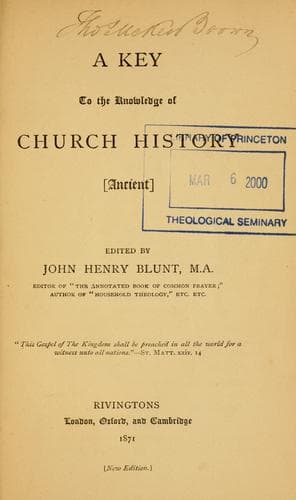
A Key to the Knowledge of Church History (Ancient)Blunt, John Henry
History
A Key to the Knowledge of Church History (Ancient)
Blunt, John Henry
Church history -- Middle Ages, 600-1500; Church history -- Primitive and early church, ca. 30-600
The state of external isolation in which the Church of the Eastern
Empire was placed by the {137} Schism of A.D. 1054, had a tendency to
increase its exaggerated spirit of conservatism, which was also
encouraged by the indolent unenterprizing temper of the Greeks of the
later empire, whose blood had not been quickened by the same admixture
of races as had given new life to the worn out nations of the West.
[Sidenote: Effects of the Crusades.] Under these circumstances the
crusades were hardly less a cause of terror to the Greeks than were the
advances of the Turks themselves, and tended to widen rather than to
heal the unhappy breach between the Latin and Greek Churches.
[Sidenote: Unjustifiable proceedings of the Latins.] The foundation of
a Latin Patriarchate at Jerusalem, after the taking of that city in
A.D. 1099, could not but be accounted an usurpation on the part of the
Pope, which was, however, far surpassed in injustice by the erection of
a Latin empire and a Latin Patriarchate in Constantinople itself, A.D.
1204. During the time that this oppressive arrangement lasted (i.e.
till A.D. 1261) the rightful Patriarch took refuge at the court which
the Eastern emperors held at Nicaea in Asia Minor, and the fugitives
there clung to their national Church, and her rightful independence.
[Sidenote: Attempts at reunion.] The Emperor Michael Palaeologus, after
driving out the Latins from Constantinople, endeavoured once more to
effect a reunion between East and West, partly from political and
partly from personal motives, and a formal act of union was signed,
A.D. 1274. Neither the Greek Clergy nor the Greek people would,
however, consent to give up their own national religious customs, nor
to acknowledge the supremacy of the Pope; and this shadow of union died
out with the death of the Emperor, its originator. [Sidenote: Invasion
of the Turks.] In the fourteenth century {138} the Turks were
treacherously invited over to Europe as allies of the usurper, John
Cantacuzenus (A.D. 1347-A.D. 1353), and so firm a footing did they
gain, that the rightful Emperor, John Palaeologus (A.D. 1341-A.D.
1391), found himself obliged to appeal to Rome for aid, promising in
return to reconcile the Greek Church to the Roman communion. The
affairs of Western Europe, were, however too unsettled to admit of such
aid being afforded, and the Emperor was obliged to give up all his
possessions to the Turks, except Constantinople, Thessalonica, part of
the Morea, and a few islands. Another appeal was made, with the same
results, by his son, Manuel Palaeologus (A.D. 1391-A.D. 1425).
[Sidenote: New attempts at reunion.] John VII. (A.D. 1425-A.D. 1448)
opened fresh negociations with the West, and he and the Patriarch of
Constantinople, together with twenty-one other Eastern Bishops,
appeared (A.D. 1438) at the Council of Ferrara (afterwards transferred
to Florence). At this council a decree of union was once more signed
Public-domain text, read in full here on John Shaqi.
Reviews
Reviews
No reviews yet
Be the first to share your thoughts on this work.
Elsewhere in the archive
Join the Discussion
Join the discussion
Sign in to leave a comment or review.
Sign InorCreate an account