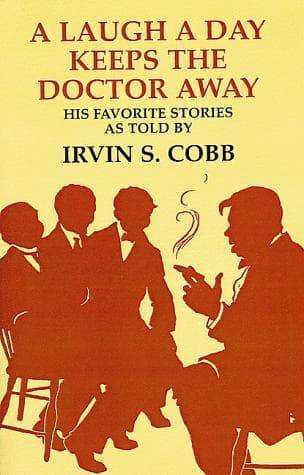
A laugh a day keeps the doctor awayCobb, Irvin S. (Irvin Shrewsbury)
General
A laugh a day keeps the doctor away
Cobb, Irvin S. (Irvin Shrewsbury)
American wit and humor; Anecdotes
§ 240 The Happy Return
Egbert, aged seven, went to the Sunday-school picnic. For days he had
been looking forward to the event; but, as in the case of so many other
things, realization hardly measured up to anticipation.
In the wagon on the way to the picnic ground, Egbert had a personal
difference with a fellow-passenger. He came out of the altercation
second best. Shortly after his arrival at the scene of festivities he
sat down on a bumble-bee, with the result that he was painfully stung.
Then he fell in the creek. A little girl took offence at a perfectly
innocent pleasantry on his part and smacked his face and pulled his
hair. He got badly sunburnt.
Late in the afternoon Egbert, in a disheveled state, reached home. As he
limped up the front steps his father, glancing up from the evening
paper, said:
“Well, son, what sort of a time did you have at the picnic?”
“Papa,” said Egbert, “I’m so glad I’m back I’m glad I went.”
§ 241 Bringing in the Sheaves
This story may or may not be true, but in view of the drops in the
currencies of certain European countries which suffered heavily in the
Great War, I am inclined to think it at least has a plausible sound to
it.
It is said that a Swiss hotel-keeper made an announcement which was
calculated to bring him the patronage of refugee notables from other
lands. He gave it out that at current rates of exchange, he would accept
money of any Continental nation in settlement of accounts. As a
consequence, his establishment was at once filled up with distinguished
exiles.
An Austrian asked for his bill. He glanced at the figures and then
heaved a heavy suitcase upon the desk of the proprietor.
“You will find enough money in this bag to pay you,” he said.
Next to come was a German nobleman. Upon learning the amount of his
indebtedness he produced a yellow slip and put it into the hand of the
Swiss.
“This,” he said, “is the bill of lading for a carload of marks which
arrived yesterday, consigned to me. The car is now at the station. Go
there and get as many bales as you need.”
The third patron was a Russian prince. After a glance at his bill he
drew from an inner pocket a flat thin heavy package which gave off a
metallic sound as he deposited it upon the desk-top.
“What’s this?” asked the hotel-keeper.
“These,” said the Russian, “are the engraver’s plates. Kindly take them
and print as many million-ruble notes as may be required.”
§ 242 Regarding the Brooklyn Boys
It would seem that a person named George customarily patronized a
certain bar wherein gathered nightly a group of men whose highest
ambition was to be on their feet when all the others were under the
table, and whose proudest boast was that they had never been known to
“pass out of the picture.” To these ambitions George subscribed.
Public-domain text, read in full here on John Shaqi.
Reviews
Reviews
No reviews yet
Be the first to share your thoughts on this work.
Elsewhere in the archive
Join the Discussion
Join the discussion
Sign in to leave a comment or review.
Sign InorCreate an account