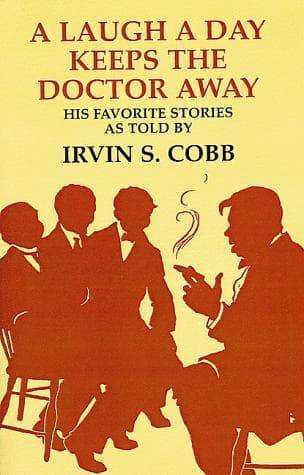
A laugh a day keeps the doctor awayCobb, Irvin S. (Irvin Shrewsbury)
General
A laugh a day keeps the doctor away
Cobb, Irvin S. (Irvin Shrewsbury)
American wit and humor; Anecdotes
This yarn, which is of English origin, requires quite a bit of
stage-setting. We are expected to imagine a village green in the
morning. The official village drunkard is revealed in the foreground. It
is evident that he has had a hard night. He leans against the village
pump, pressing his throbbing temples to the cool iron work. Ambling up
to him with a smile of gratification on his chubby cheeks, comes the
curate of the parish.
“Good morning, Walker,” says the curate briskly.
“Mornin’,” says Walker, opening one eye wanly but not shifting his
position.
“Walker,” continues the curate, “I want to tell you that I was most
pleased—although, I must confess, a bit surprised as well—to see you
among those present at vesper services last evening.”
“Ow,” says Walker; “so that’s where I was, was I?”
§ 322 It Very Often Proves Fatal
A literal and simple-minded man, by birth a German, sent his wife to the
hospital for an operation. The operation was performed in the forenoon.
In the afternoon, when he quit work, the husband called to inquire how
the patient had stood the ordeal. The nurse told him that she seemed to
be improving.
Early the next morning he was on hand asking for the latest tidings from
the sick-room, and again he was informed that his wife still appeared to
be improving. Twice daily all through the week he received similar
reports.
But one morning when he called he was met with the distressing news that
she had passed away. In a daze the widower started down the street to
find an undertaking establishment. On the way he met an acquaintance and
the latter said:
“Well, how’s your wife to-day?”
“She iss dead,” answered the bereft one.
“Ach!” said his friend. “That’s too bad. I thought she was getting along
first rate. What did she die of?”
“Improvements.”
§ 323 Proving That Figures Don’t Lie
Three patricians of the coal yards fared forth on mercy bent, each in
his great black chariot. Their overlord, the yard superintendent, had
bade them deliver to seven families a total of twenty-eight tons of coal
equally divided.
Well out of the yards, each with his first load, Kelly and Burke and
Shea paused to discuss the problem of equal distribution—how much coal
should each family get?
“’Tis this way,” argued Burke. “’Tis but a bit of mathematics. If there
are 7 families an’ 28 tons o’ coal ye divide 28 by 7, which is done as
follows: Seven into 8 is 1, 7 into 21 is 3, which makes 13.”
He triumphantly exhibited his figures made with a stubby pencil on a bit
of grimy paper:
7/28/13
7
—
21
21
—
00
Public-domain text, read in full here on John Shaqi.
Reviews
Reviews
No reviews yet
Be the first to share your thoughts on this work.
Elsewhere in the archive
Join the Discussion
Join the discussion
Sign in to leave a comment or review.
Sign InorCreate an account