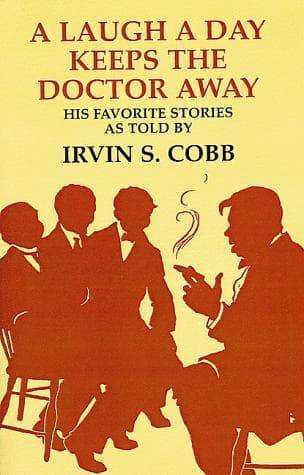
A laugh a day keeps the doctor awayCobb, Irvin S. (Irvin Shrewsbury)
General
A laugh a day keeps the doctor away
Cobb, Irvin S. (Irvin Shrewsbury)
American wit and humor; Anecdotes
A somewhat inexperienced but quick-witted Texan acted as referee. It
subsequently developed that, contrary to the ethics, the referee had a
private bet on one of the scrappers. Midway of the fight, it appeared
highly probable that his favorite would shortly be knocked out and so,
to save his money, the referee, at the end of the tenth round, declared
the bout a draw, and ended it right there.
Enraged and disappointed, the audience rose up, shouting threats. The
native contingent was especially vociferous. A first-class riot was
threatened.
But the imperiled referee had a smart notion in reserve. By waving his
arms and shouting that he had a statement to make, he secured
comparative silence. Then he made his announcement and it proved
eminently satisfactory. The Americans present saw the point of the joke;
the Mexicans were appeased because the explanation seemed to them
perfectly sound.
“Gentlemen,” the referee said, “this was advertised as a twenty-round
fight and that’s exactly what it is—twenty rounds Mex. or ten rounds
American.”
§ 339 Classifying the Delinquent
Years ago, when I was a reporter for a New York evening paper, and
covered trials at the Criminal Courts Building, there was an elderly and
very devout Irishman who had a job in Part Two of General Sessions. It
was his duty to keep order and to act as door-keeper, on occasion, and
sometimes as a sort of usher. But he particularly shone on those
occasions when he was called upon to aid in taking the so-called
pedigree of a newly convicted defendant.
In this matter a certain routine invariably was followed. The prisoner
would be arraigned at the bar. The old Irishman would range alongside
him and in an undertone ask of him certain questions, then call out the
answers to the clerk sitting fifteen feet away, who duly recorded them
on the back of the indictment. This ceremony was more or less automatic,
since from long experience the old man knew exactly what facts regarding
the prisoner’s past life he must ascertain. As the convicted man usually
made his responses in an undertone, only the functionary’s voice would
be heard as he chanted his own version of the disclosures just made to
him.
One day a youth of a most forbidding appearance, who had been found
guilty of attempted highway robbery, was brought up. The old Irishman
edged up to him and in a friendly confidential half-whisper asked him
for his right name.
“Henry Smith,” returned the youth, in a surly grumble out of one corner
of his mouth.
“He says Henry Smith, Mr. Penney,” called out the Irishman. Then he
turned again to the malefactor:
“Born in the United States?”
“Sure—Brooklyn.”
“Native-born, Mr. Penney.”
“Any religious instruction in your youth, young man?”
“No,” shortly.
“PROTESTANT, Mr. Penney.”
§ 340 A Touch of the Swedish
Public-domain text, read in full here on John Shaqi.
Reviews
Reviews
No reviews yet
Be the first to share your thoughts on this work.
Elsewhere in the archive
Join the Discussion
Join the discussion
Sign in to leave a comment or review.
Sign InorCreate an account