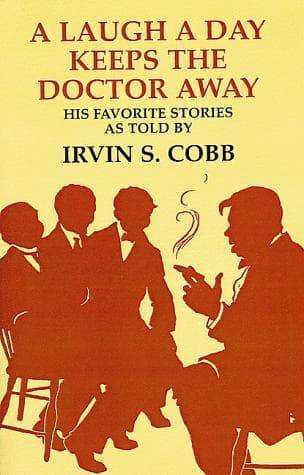
A laugh a day keeps the doctor awayCobb, Irvin S. (Irvin Shrewsbury)
General
A laugh a day keeps the doctor away
Cobb, Irvin S. (Irvin Shrewsbury)
American wit and humor; Anecdotes
“‘Does Henry Smith, Jr., live here?’ asked the father.
“‘Yes,’ said the old lady, wearily. ‘Carry him in.’”
§ 343 Or in Other Words, Slightly Confused
I have always been interested in the character of Daniel Boone. It
seemed to me that of all our early pioneers he, perhaps, was the most
gallant and the most picturesque, and certainly the most typical.
A few months ago a collector of early Kentucky lore told me a story of
the great pathfinder. I leaped upon it with loud cries of joy. I said to
myself that if it were not true it deserved to be true. So far as my
informant knew, it had never been printed but instead had been handed
down by word of mouth from one generation to another. So I just was
making ready to plunge into the arena with a brand new contribution to
pioneer Americana when I sustained a severe shock.
This shock was the discovery that the same anecdote, in substantially
the same form in which I heard it told by my Kentucky friend, already
had appeared in print. It was published a trifling matter of one hundred
and two years ago. Even so, I offer it here again for the reason I
believe it has merit in it entitling it to perpetuation.
It appears that in 1819 Chester Harding, an artist, being prompted by a
patriotic impulse made the long journey from his home on the eastern
seaboard to Missouri, which then was in the far West, for the purpose of
meeting the aged Boone and painting his portrait. At the time of
Harding’s arrival Boone had left his log-cabin home and had gone on one
of his periodical outings into the wilderness. The visitor followed
along an obscure trail until he came to a tumbledown shanty. To quote
Harding’s words, “I found him engaged in cooking his dinner. He was
lying in his bunk, near the fire, and had a long strip of venison wound
around his ramrod, and was busy turning it before a brisk blaze, and
using pepper and salt to season his meat.
“I at once told him the object of my visit. I could tell that he did not
exactly know what I meant. I explained the matter to him, and he agreed
to sit. He was nearly ninety years old, and rather infirm; his memory of
passing events was much impaired, yet he would amuse me every day by his
anecdotes of his earlier life. I asked him one day, just after his
description of one of his long hunts, if he never got lost, having no
compass. ‘No’, said he, ‘I can’t say as ever I was lost, but I was
_bewildered_ once for three days.’”
§ 344 A Squirrel without a Peer
In the wicked days when drinking still was going on, Riley Wilson, the
official humorist of West Virginia, met on the streets of Huntington a
friend of his from up in the mountains. Extending the customary
hospitalities, Wilson invited the hillsman to have something. The
visitor was agreeably inclined. They crossed the street and entered the
swinging doors of a life-saving station.
Public-domain text, read in full here on John Shaqi.
Reviews
Reviews
No reviews yet
Be the first to share your thoughts on this work.
Elsewhere in the archive
Join the Discussion
Join the discussion
Sign in to leave a comment or review.
Sign InorCreate an account