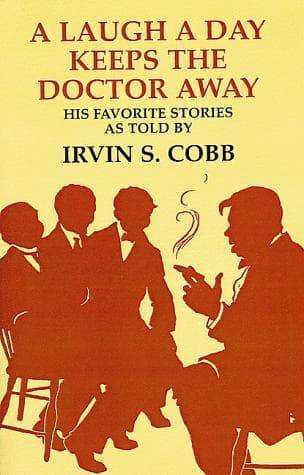
A laugh a day keeps the doctor awayCobb, Irvin S. (Irvin Shrewsbury)
General
A laugh a day keeps the doctor away
Cobb, Irvin S. (Irvin Shrewsbury)
American wit and humor; Anecdotes
“Honey,” said her mother, “I can understand why you should be proud of
your birthday gifts, but grown people are not interested in such things.
You may come to dinner to-night on condition that you do not once
mention your wrist-watch or your bottle of perfumery.”
The little one promised. At the table she sat, saying not a word, but
from time to time sniffing audibly, and at frequent intervals raising
her left wrist to her ear to catch the sound of the ticking. These
tactics failed to attract attention. Toward the end of the meal, in a
lull in the conversation, little Miss Helen spoke:
“Listen, everybody,” she said. “If anybody hears anything or smells
anything, it’s me.”
§ 96 The Truth from the Inside
The dining car waiter was one of those persons who feel a sense of
personal proprietorship in the institutions they serve—a type not at
all uncommon among members of his race. His manner, his voice, all about
him, subtly conveyed the idea that here was one who took a deep pride in
the undertaking of feeding people on a transcontinental train, and was
determined that no blot ever should besmirch the fair name of the
system.
So when the gentleman who was going to California gave a breakfast order
of grapefruit, toast, coffee and soft-boiled eggs, he bent over the
patron and in confidential tones whispered:
“Boss, I would not keer to reccermend the aigs this mawnin’! Naw, suh, I
would suggest you tuck somethin’ else on the bill.”
“What’s the matter with the eggs—aren’t they fresh?” asked the
customer.
The waiter’s voice sank still lower.
“I don’t know ef they’s fresh or ef they ain’t,” he said; “but to tell
you the truth, we ain’t got none.”
§ 97 The Fate of the Saloon
In the last months of the fighting in 1918, a draft regiment of colored
troops from the Gulf States went in near the Flanders line, where the
British held, to help mop up the retreating Germans. One morning three
of my fellow-correspondents borrowed a staff car and rode up to an
abandoned village where there had been sharp fighting, seeking for a
forward dressing-station with intent to get stories from wounded men.
At an entrance to an improvised hospital in a dugout one of the group
came upon a coal-black infantryman who, while not seriously injured,
bore unmistakable signs of having come into abrupt contact with some
form of high and violent explosive. He was wearing, for the moment, his
belt and his boots and a part of his collar. The correspondent said to
him:
“Soldier, how did you get hurt?”
“Well, mister,” stated the victim, “it ain’t altogether clear in my own
mind yit, but I could mebbe tell you some of de things w’ich hez
occurred.”
“I should be very pleased to hear them.”
Public-domain text, read in full here on John Shaqi.
Reviews
Reviews
No reviews yet
Be the first to share your thoughts on this work.
Join the Discussion
Join the discussion
Sign in to leave a comment or review.
Sign InorCreate an account