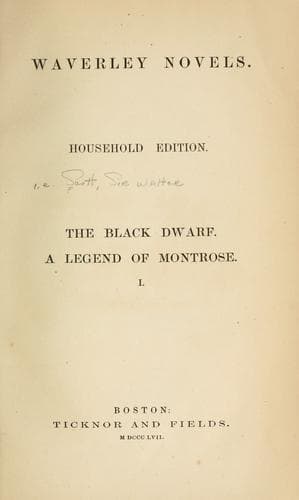
Historical fiction; Montrose, James Graham, Marquis of, 1612-1650 -- Fiction; Scotland -- History -- Charles I, 1625-1649 -- Fiction
For this purpose, Argyle once more moved towards Inverary, having an
opportunity, at every step, to deplore the severities which the hostile
clans had exercised on his dependants and country. Whatever noble
qualities the Highlanders possessed, and they had many, clemency in
treating a hostile country was not of the number; but even the ravages
of hostile troops combined to swell the number of Argyle’s followers.
It is still a Highland proverb, He whose house is burnt must become a
soldier; and hundreds of the inhabitants of these unfortunate valleys
had now no means of maintenance, save by exercising upon others the
severities they had themselves sustained, and no future prospect of
happiness, excepting in the gratification of revenge. His bands were,
therefore, augmented by the very circumstances which had desolated his
country, and Argyle soon found himself at the head of three thousand
determined men, distinguished for activity and courage, and commanded by
gentlemen of his own name, who yielded to none in those qualities. Under
himself, he conferred the principal command upon Sir Duncan Campbell of
Ardenvohr, and another Sir Duncan Campbell of Auchenbreck, [This last
character is historical] an experienced and veteran soldier, whom he had
recalled from the wars of Ireland for this purpose. The cold spirit
of Argyle himself, however, clogged the military councils of his
more intrepid assistants; and it was resolved, notwithstanding their
increased force, to observe the same plan of operations, and to follow
Montrose cautiously, in whatever direction he should march, avoiding an
engagement until an opportunity should occur of falling upon his rear,
while he should be engaged with another enemy in front.
CHAPTER XVIII.
Piobracht au Donuil-dhu,
Piobrachet au Donuil,
Piobrachet agus S’breittach
Feacht an Innerlochy.
The war-tune of Donald the Black,
The war-tune of Black Donald,
The pipes and the banner
Are up in the rendezvous of Inverlochy.
The military road connecting the chains of forts, as it is called, and
running in the general line of the present Caledonian Canal, has now
completely opened the great glen, or chasm, extending almost across
the whole island, once doubtless filled by the sea, and still affording
basins for that long line of lakes, by means of which modern art has
united the German and Atlantic Oceans. The paths or tracks by which the
natives traversed this extensive valley, were, in 1645-6, in the same
situation as when they awaked the strain of an Irish engineer officer,
who had been employed in converting them into practicable military
roads, and whose eulogium begins, and, for aught I know, ends, as
follows:
Had you seen but these roads before they were made, You would have held
up your hands and bless’d General Wade.
Public-domain text, read in full here on John Shaqi.
Reviews
Reviews
No reviews yet
Be the first to share your thoughts on this work.
Elsewhere in the archive
Join the Discussion
Join the discussion
Sign in to leave a comment or review.
Sign InorCreate an account