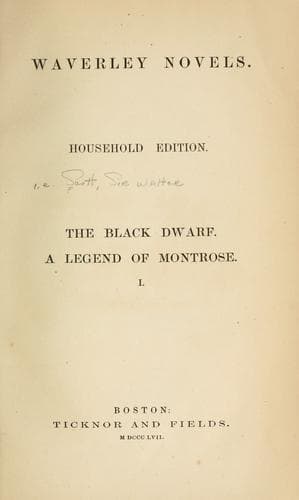
Historical fiction; Montrose, James Graham, Marquis of, 1612-1650 -- Fiction; Scotland -- History -- Charles I, 1625-1649 -- Fiction
On the right of the Campbells, the Knight of Ardenvohr obtained some
advantage, through his military skill and by strength of numbers. He had
moved forward obliquely the extreme flank of his line at the instant the
Royalists were about to close, so that they sustained a fire at once
on front and in flank, and, despite the utmost efforts of their leader,
were thrown into some confusion. At this instant, Sir Duncan Campbell
gave the word to charge, and thus unexpectedly made the attack at
the very moment he seemed about to receive it. Such a change of
circumstances is always discouraging, and often fatal. But the disorder
was remedied by the advance of the Irish reserve, whose heavy and
sustained fire compelled the Knight of Ardenvohr to forego his
advantage, and content himself with repulsing the enemy. The Marquis
of Montrose, in the meanwhile, availing himself of some scattered birch
trees, as well as of the smoke produced by the close fire of the Irish
musketry, which concealed the operation, called upon Dalgetty to follow
him with the horse, and wheeling round so as to gain the right flank and
even the rear of the enemy, he commanded his six trumpets to sound
the charge. The clang of the cavalry trumpets, and the noise of the
galloping of the horse, produced an effect upon Argyle’s right wing
which no other sounds could have impressed them with. The mountaineers
of that period had a superstitious dread of the war-horse, like that
entertained by the Peruvians, and had many strange ideas respecting the
manner in which that animal was trained to combat. When, therefore, they
found their ranks unexpectedly broken, and that the objects of their
greatest terror were suddenly in the midst of them, the panic, in spite
of Sir Duncan’s attempts to stop it, became universal. Indeed, the
figure of Major Dalgetty alone, sheathed in impenetrable armour, and
making his horse caracole and bound, so as to give weight to every
blow which he struck, would have been a novelty in itself sufficient to
terrify those who had never seen anything more nearly resembling such
a cavalier, than a SHELTY waddling under a Highlander far bigger than
itself. The repulsed Royalists returned to the charge; the Irish,
keeping their ranks, maintained a fire equally close and destructive.
There was no sustaining the fight longer. Argyle’s followers began
to break and fly, most towards the lake, the remainder in different
directions. The defeat of the right wing, of itself decisive, was
rendered irreparable by the death of Auchenbreck, who fell while
endeavouring to restore order.
Public-domain text, read in full here on John Shaqi.
Reviews
Reviews
No reviews yet
Be the first to share your thoughts on this work.
Elsewhere in the archive
Join the Discussion
Join the discussion
Sign in to leave a comment or review.
Sign InorCreate an account