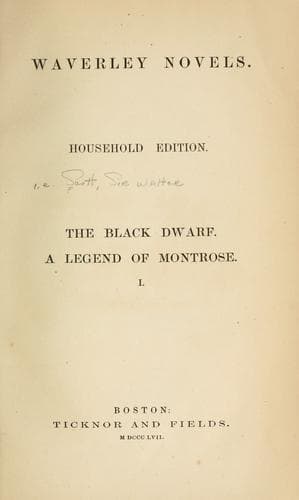
Historical fiction; Montrose, James Graham, Marquis of, 1612-1650 -- Fiction; Scotland -- History -- Charles I, 1625-1649 -- Fiction
“If nature has given him such,” said Menteith, “habit has converted them
into feelings of intense selfishness. He may be punctilious concerning
his reputation, and brave in the execution of his duty, but it is only
because without these qualities he cannot rise in the service;--nay, his
very benevolence is selfish; he may defend his companion while he can
keep his feet, but the instant he is down, Sir Dugald will be as ready
to ease him of his purse, as he is to convert the skin of Gustavus into
a buff jerkin.”
“And yet, if all this were true, cousin,” answered Montrose, “there is
something convenient in commanding a soldier, upon whose motives and
springs of action you can calculate to a mathematical certainty. A fine
spirit like yours, my cousin, alive to a thousand sensations to which
this man’s is as impervious as his corslet,--it is for such that thy
friend must feel, while he gives his advice.” Then, suddenly changing
his tone, he asked Menteith when he had seen Annot Lyle.
The young Earl coloured deeply, and answered, “Not since last
evening,--excepting,” he added, with hesitation, “for one moment, about
half an hour before the battle began.”
“My dear Menteith,” said Montrose, very kindly, “were you one of the gay
cavaliers of Whitehall, who are, in their way, as great self-seekers
as our friend Dalgetty, should I need to plague you with enquiring into
such an amourette as this? it would be an intrigue only to be laughed
at. But this is the land of enchantment, where nets strong as steel are
wrought out of ladies’ tresses, and you are exactly the destined knight
to be so fettered. This poor girl is exquisitely beautiful, and has
talents formed to captivate your romantic temper. You cannot think of
injuring her--you cannot think of marrying her?”
“My lord,” replied Menteith, “you have repeatedly urged this jest, for
so I trust it is meant, somewhat beyond bounds. Annot Lyle is of unknown
birth,--a captive,--the daughter, probably, of some obscure outlaw; a
dependant on the hospitality of the M’Aulays.”
“Do not be angry, Menteith,” said the Marquis, interrupting him; “you
love the classics, though not educated at Mareschal-College; and you may
remember how many gallant hearts captive beauty has subdued:--
Movit Ajacem, Telamone natum,
Forma captivae dominum Tecmessae.
In a word, I am seriously anxious about this--I should not have time,
perhaps,” he added very gravely, “to trouble you with my lectures on the
subject, were your feelings, and those of Annot, alone interested; but
you have a dangerous rival in Allan M’Aulay; and there is no knowing to
what extent he may carry his resentment. It is my duty to tell you that
the King’s service may be much prejudiced by dissensions betwixt you.”
Public-domain text, read in full here on John Shaqi.
Reviews
Reviews
No reviews yet
Be the first to share your thoughts on this work.
Elsewhere in the archive
Join the Discussion
Join the discussion
Sign in to leave a comment or review.
Sign InorCreate an account