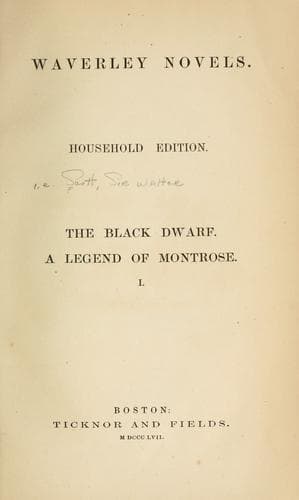
Historical fiction; Montrose, James Graham, Marquis of, 1612-1650 -- Fiction; Scotland -- History -- Charles I, 1625-1649 -- Fiction
The furious declaration of Allan had destroyed the romantic plan which
she had formed, of nursing in secret her pensive tenderness, without
seeking any other requital. Long before this, she had dreaded Allan, as
much as gratitude, and a sense that he softened towards her a temper so
haughty and so violent, could permit her to do; but now she regarded him
with unalloyed terror, which a perfect knowledge of his disposition, and
of his preceding history, too well authorised her to entertain. Whatever
was in other respects the nobleness of his disposition, he had never
been known to resist the wilfulness of passion,--he walked in the house,
and in the country of his fathers, like a tamed lion, whom no one dared
to contradict, lest they should awaken his natural vehemence of passion.
So many years had elapsed since he had experienced contradiction, or
even expostulation, that probably nothing but the strong good sense,
which, on all points, his mysticism excepted, formed the ground of his
character, prevented his proving an annoyance and terror to the whole
neighbourhood. But Annot had no time to dwell upon her fears, being
interrupted by the entrance of Sir Dugald Dalgetty.
It may well be supposed, that the scenes in which this person had passed
his former life, had not much qualified him to shine in female society.
He himself felt a sort of consciousness that the language of the
barrack, guard-room, and parade, was not proper to entertain ladies.
The only peaceful part of his life had been spent at Mareschal-College,
Aberdeen; and he had forgot the little he had learned there, except the
arts of darning his own hose, and dispatching his commons with unusual
celerity, both which had since been kept in good exercise by the
necessity of frequent practice. Still it was from an imperfect
recollection of what he had acquired during this pacific period, that
he drew his sources of conversation when in company with women; in other
words, his language became pedantic when it ceased to be military.
“Mistress Annot Lyle,” said he, upon the present occasion, “I am just
now like the half-pike, or spontoon of Achilles, one end of which could
wound and the other cure--a property belonging neither to Spanish pike,
brown-bill, partizan, halberd, Lochaber-axe, or indeed any other modern
staff-weapon whatever.” This compliment he repeated twice; but as Annot
scarce heard him the first time, and did not comprehend him the second,
he was obliged to explain.
“I mean,” he said, “Mistress Annot Lyle, that having been the means
of an honourable knight receiving a severe wound in this day’s
conflict,--he having pistolled, somewhat against the law of arms, my
horse, which was named after the immortal King of Sweden,--I am desirous
of procuring him such solacement as you, madam, can supply, you being
like the heathen god Esculapius” (meaning possibly Apollo), “skilful
not only in song and in music, but in the more noble art of
chirurgery-OPIFERQUE PER ORBEM DICOR.”
Public-domain text, read in full here on John Shaqi.
Reviews
Reviews
No reviews yet
Be the first to share your thoughts on this work.
Elsewhere in the archive
Join the Discussion
Join the discussion
Sign in to leave a comment or review.
Sign InorCreate an account